Nuclear Medicine
How to Get AERB Approval for a Medical Cyclotron in India (2026 Step-by-Step Guide)
As more hospitals and research centres plan to establish a medical cyclotron in India, navigating the AERB approval process has become one of the most important stages of the project.
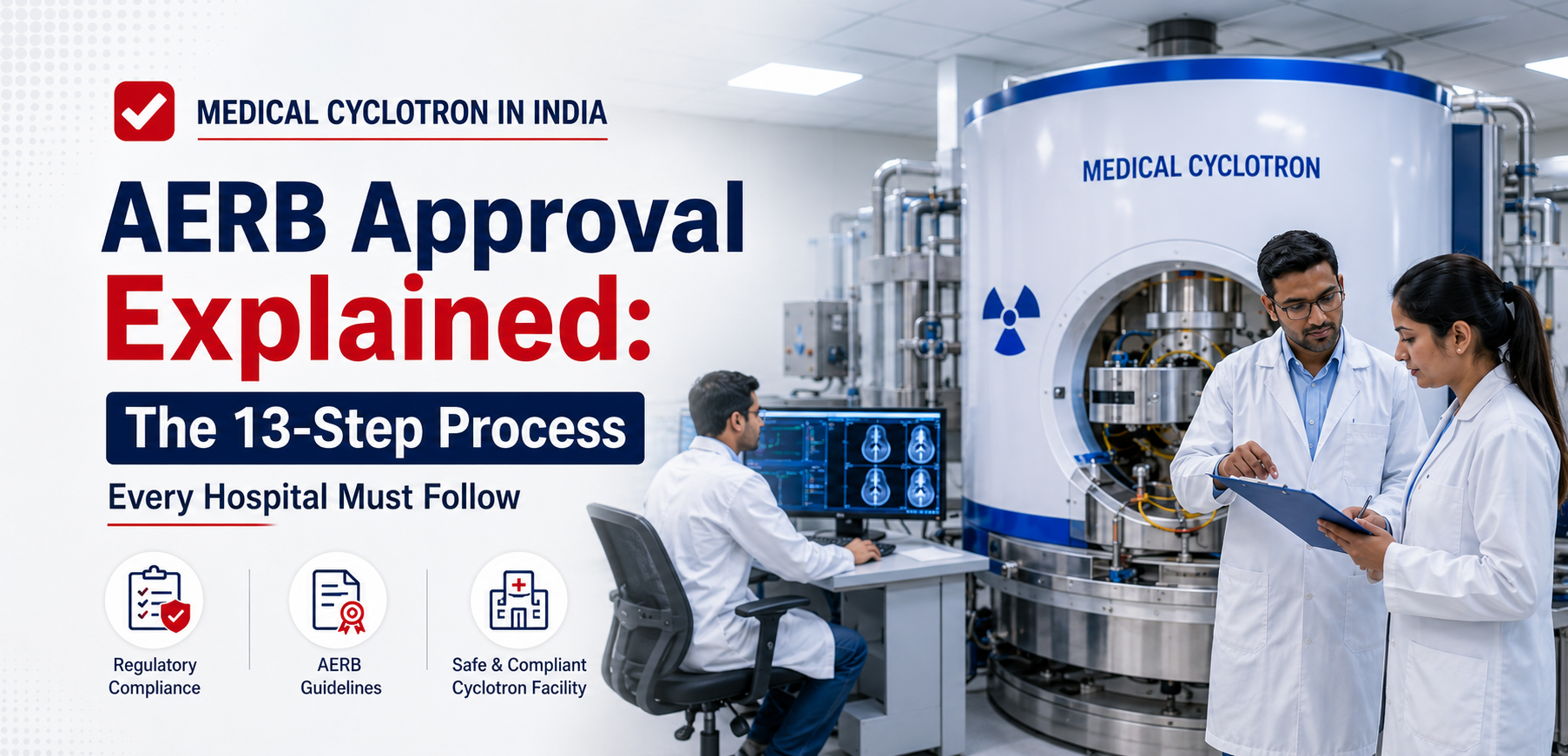
A medical cyclotron is a type of particle accelerator used to produce short-lived radioactive isotopes (radioisotopes) for medical imaging, diagnostics, and targeted cancer treatments. Since medical cyclotrons produce radioactive materials, every facility must obtain approval from the Atomic Energy Regulatory Board (AERB) before it can be imported, installed, and operated.
As more hospitals plan to establish a medical cyclotron in India, navigating the AERB approval process has become one of the most important stages of the project.
This guide explains the AERB approval process, AERB cyclotron guidelines, key regulatory documents, and how hospitals can plan a compliant cyclotron facility.
What Is a Medical Cyclotron?
A medical cyclotron is a particle accelerator that accelerates charged particles to produce short-lived radioactive isotopes used to manufacture radiopharmaceuticals.
How a Cyclotron Works
Magnetic and Electric Fields: It uses a powerful magnet to bend charged particles (like protons or ions) into a circular path, and an electric field to speed them up in a spiral motion.
Target Bombardment: Once the particles reach high energy, they crash into a target material, triggering a nuclear reaction that creates medical radioisotopes.
Image source: Sirvent Blasco, Jose Luis. (2019). Secondary Shower Acquisition Design for the CERN high Accuracy Wire Scanner.
Common isotopes include Fluorine-18 (¹⁸F), Carbon-11 (¹¹C), Nitrogen-13 (¹³N), and Oxygen-15 (¹⁵O).
Main Medical Uses
PET Scans: Produces essential short-lived positron-emitting isotopes like Fluorine-18 used in PET radiopharmaceuticals to detect cancer, heart disease, and brain disorders.
Particle Therapy: Can supply direct proton beams aimed precisely at destroying deep-seated tumors while sparing healthy surrounding tissue.
Because these radioisotopes lose their radioactivity within hours, they can't be transported over long distances. That's why more hospitals and research centres are investing in on-site cyclotrons. This ensures a reliable supply for patient care and research.
Why Is AERB Approval Required to Start a Medical Cyclotron Facility?
Medical cyclotrons generate ionising radiation and radioactive materials. To protect healthcare workers, patients, the public, and the environment, every facility must comply with regulations issued by the Atomic Energy Regulatory Board (AERB).
Before granting approval, AERB verifies that the facility has adequate radiation shielding, safe radiopharmacy infrastructure, approved radiation monitoring systems, trained staff and procedures for handling radioactive waste.
General dos and don’ts for radiation safety
Every facility must also appoint an AERB-approved Radiation Safety Officer (RSO) to oversee radiation protection and regulatory compliance.
Rather than being a single licence, AERB approval is a phased regulatory process that helps ensure a medical cyclotron facility is safe and ready for operation.
AERB Approval Process to Install a Medical Cyclotron in India
Once a hospital or a research centre decides to establish a medical cyclotron facility, the project typically progresses through the following regulatory milestones.
Step | Stage | Description |
1 | Register Institute in eLORA | Register the hospital or organization on the AERB eLORA portal to create its regulatory profile. |
2 | Site Layout, Design & Construction Approval | Submit facility layout, shielding design, HVAC, hot cells, waste management, and related documents for AERB approval before construction. |
3 | Register Radiation Professionals (RP) | Register qualified personnel such as Cyclotron Operators and Radiopharmacists with AERB. Eligible personnel may later serve as the RSO. |
4 | Register Radiation Monitoring Instruments | Register calibrated radiation survey meters, contamination monitors, dosimetry systems, and other monitoring equipment. |
5 | Assign Radiation Professionals | Link all approved Radiation Professionals to the licensed cyclotron facility. |
6 | Obtain RSO Approval | Nominate and obtain approval for a Radiation Safety Officer (RSO) responsible for radiation protection and regulatory compliance. |
7 | Apply for Cyclotron Procurement/Import | Obtain AERB authorization before purchasing or importing the medical cyclotron. |
8 | Intimate Receipt of Cyclotron | Notify AERB after the cyclotron is received to update regulatory records. |
9 | Obtain Trial Run / Commissioning Permission | Receive approval to perform commissioning, radiation surveys, safety tests, and system validation. |
10 | Commissioning & Performance Verification | Verify beam performance, radionuclide production, radiation safety, hot cells, QC systems, and overall operational readiness. |
11 | Obtain Licence for Operation | After successful commissioning, receive the AERB licence to begin routine production of PET radioisotopes. |
12 | Apply for Decommissioning Approval | Submit a decommissioning plan covering dismantling, radiation safety, contamination assessment, and waste management. |
13 | Intimate Completion of Decommissioning | Notify AERB after decommissioning is completed and all radioactive hazards have been safely managed. |
AERB Cyclotron Approval Process
AERB Documents and Guidelines
Detailed information is available here: AERB cyclotron PDF, AERB cyclotron guidelines, and AERB/RF-RS/SG-3 while planning a new facility.
These publications provide the regulatory framework for facility planning, licensing, radiation safety, inspection, and routine operation. Reviewing the latest guidance early in the project helps minimise documentation gaps and reduce approval delays.
Planning tip: Involving experienced cyclotron infrastructure specialists and radiation safety experts early in the project can minimise approval delays, avoid costly redesigns, and keep the project on schedule.
Common Challenges of Setting Up a Medical Cyclotron
Establishing a medical cyclotron in India involves much more than purchasing equipment. Hospitals must coordinate infrastructure planning, radiation shielding, radiopharmacy design, specialised HVAC systems, utilities, equipment installation, commissioning, and regulatory documentation.
Even small design changes during construction can increase costs, delay approvals, and affect project timelines. Managing multiple contractors while meeting stringent AERB approval requirements adds further complexity. There are several challenges in cyclotron facility operations too, whether for medical or commercial use.
An experienced project partner can simplify this process by bringing together technical expertise, regulatory knowledge, infrastructure planning, and project management under one roof. This reduces coordination challenges and helps projects move forward more efficiently.
Why Partner with Global CanCare?
Global CanCare provides end-to-end support throughout the medical cyclotron project lifecycle. From feasibility studies and technology selection to radiation shielding, radiopharmacy design, AERB documentation, commissioning, and operational readiness, our team supports every stage of implementation.
Instead of managing multiple consultants and vendors, hospitals and research centres can benefit from a single point of coordination. This integrated approach reduces project risks, improves execution, and helps establish compliant, future-ready nuclear medicine facilities.
Did you know?
The first cyclotron in India was built and made functional in 1954 at the University of Calcutta under the leadership of physicist Basanti Dulal Nagchaudhuri, following the vision of Meghnad Saha.
B. D. Nag Chaudhuri (second from left) with Meghnad Saha and colleagues. Source: Anandabazar Patrika.
Final Thoughts
As demand for PET imaging and theranostics continues to grow, investing in a medical cyclotron in India is becoming a strategic priority for hospitals and diagnostic networks.
While obtaining AERB approval is a critical milestone, successful projects begin with careful planning, compliant infrastructure, and coordinated execution.
With expertise across the entire project lifecycle, Global CanCare helps hospitals establish safe, compliant, and operational medical cyclotron facilities—enabling advanced nuclear medicine services with confidence.
Ready to Establish a Medical Cyclotron Facility?
Planning a new cyclotron or expanding your nuclear medicine capabilities? Our experts can help you navigate every stage of the project.
Contact Global CanCare
Visit: https://globalcancare.com
Email: info@globalcancare.com
Phone: +91 81201 15666 | +91 90987 93898 | +91 79746 67979
Get in touch with one of our regional teams in the UK, USA, Australia, or UAE for international enquiries.
Sources:
Atomic Energy Regulatory Board (AERB). eLORA: Electronic Licensing of Radiation Applications. Government of India.
Atomic Energy Regulatory Board (AERB). Medical Cyclotron Facilities. AERB Safety Guide No. AERB/RF/RS/SG-3. Mumbai: Atomic Energy Regulatory Board, 2016.
Atomic Energy Regulatory Board (AERB). RSO eLORA Guidelines. Government of India.
Atomic Energy Regulatory Board (AERB). RSO Training: Standard Syllabi and Certification Courses. Government of India.
Stevenson, N. R. “The Challenges of Commercial Cyclotron Radioisotope Production.” In Proceedings of the Second School and Workshop on Cyclotrons and Applications (CCW'97), 212–215. Cairo, Egypt, 1998.
Kumar, Rajeev. “Challenges in Cyclotron Facility.” In Proceedings of the Third Annual Conference of the Nuclear Medicine Physicists Association of India: Theranostics—The Future Is Here. Palghar, India: Nuclear Medicine Physicists Association of India, 2019.
“Secondary Shower Acquisition Design for the CERN High Accuracy Wire Scanner.” ResearchGate.
International Atomic Energy Agency (IAEA). “What Is a Cyclotron?” IAEA News.
Johns Hopkins Medicine. Proton Therapy
“Common Types of Radionuclide Sources.” Figure in a scientific publication. ResearchGate.
Manna, Arghya. “Meghnad theke Meghnad: Hindu Dharmer Gonramir Proti Bidbeshe Nijer Nam Bodle Phelechhilen Meghnad Saha” Anandabazar Patrika, November 3, 2018.
Planning a Cancer Care project?
Our specialists can scope equipment, shielding, licensing and staffing for your facility.
Talk to our team