
healthcare technology, radiotherapy
How to Get AERB Approval for a LINAC Machine in India: A Complete Guide to Setting Up a LINAC Radiotherapy Centre
Planning to install a LINAC radiation therapy machine? Before the first beam is ever switched on, AERB approval is mandatory. From bunker design and shielding to commissioning and clinical readiness, here’s what hospitals need to know—and how Global CanCare can help navigate the process from start to finish.
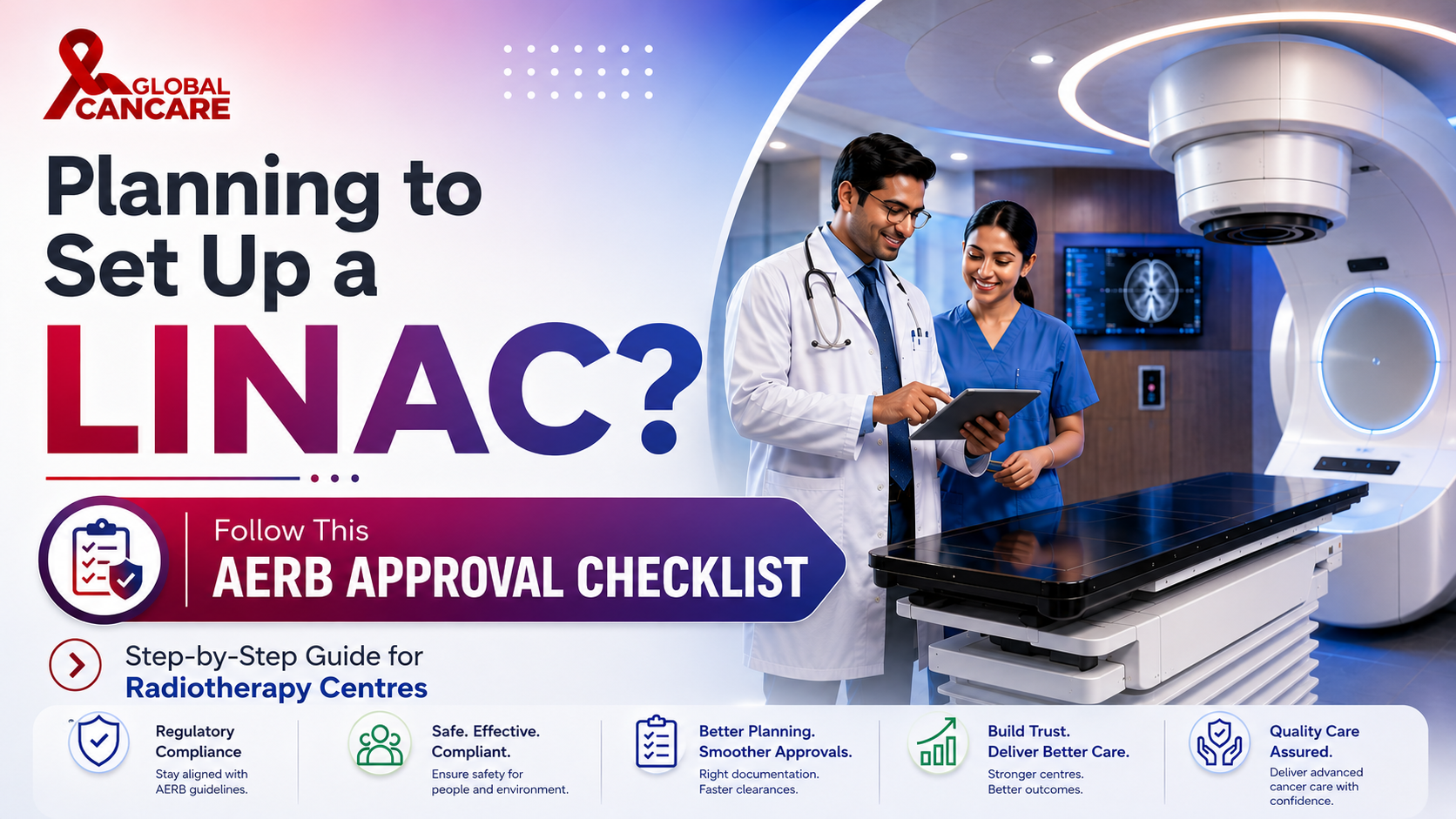
Getting AERB approval for a Linear Accelerator (LINAC) machine in India requires a strict regulatory process managed by the Atomic Energy Regulator Board. Healthcare facilities must secure clearances across multiple stages—including layout approval, procurement of type-approved equipment, appointment of a certified Radiation Safety Officer (RSO), and final licensing—exclusively through the online e-LORA (e-Licensing of Radiation Applications) platform.
If you are planning to set up a new radiotherapy centre, expand an existing cancer facility, or install a LINAC, understanding these requirements early can help prevent costly changes, delays, and compliance issues.
This article explains the LINAC AERB approval process in simple terms, from planning and layout approval to installation and the final licence to operate.
What Is a LINAC Machine and How Effective Is It in Cancer Treatment?
A LINAC (Linear Accelerator) machine delivers high-energy X-rays or electrons to precisely target cancer cells. Modern LINAC radiotherapy machines support advanced techniques such as IMRT, VMAT and IGRT.
According to IARC's Global Cancer Observatory (GLOBOCAN 2024), India recorded 1,562,581 new cancer cases, 901,828 cancer deaths and 3,324,140 five-year prevalent cases in 2024, underscoring the growing need for accessible, high-quality cancer treatment infrastructure, including modern radiotherapy services.
Image source: International Agency for Research on Cancer (IARC), World Health Organization, Global Cancer Observatory — India: Statistics at a Glance, 2024.
According to the IAEA, around 50% of cancer patients worldwide could benefit from radiotherapy, while radiotherapy contributes to the cure of about 40% of patients who are ultimately cured of cancer, either alone or alongside surgery or chemotherapy.
The effectiveness varies by cancer type, stage and treatment plan, but these figures highlight why a LINAC for radiation therapy is a cornerstone of modern cancer care.
Step-by-Step AERB Approval Process for Setting Up a LINAC Machine
AERB approval for a LINAC machine is not a single certificate. For a new medical linear accelerator, AERB uses the eLORA system to manage a sequence of regulatory approvals covering the facility, radiation safety, equipment, commissioning and clinical operation.
Step 1: Plan the Radiotherapy Centre
Define the clinical services, treatment techniques, LINAC specifications, CT simulator, treatment-planning system, QA equipment and staffing requirements before finalising the bunker design.
Step 2: Select the LINAC and Define Its Specifications
Consider energy, workload, imaging, treatment techniques, software, room configuration and other technical requirements. A 6 MV LINAC, for example, may have different shielding requirements from a higher-energy system.
Step 3: Obtain AERB Site and Layout Approval
Submit the proposed treatment room, control room, maze, entrances and surrounding facilities for AERB approval. The layout should account for areas above, below and around the bunker.
Step 4: Design the LINAC Radiation Shielding
Calculate shielding requirements based on energy, workload, beam directions, occupancy and surrounding areas. Primary and secondary barriers, roof, maze, doors and service penetrations must be considered.
Step 5: Assess the Areas Around the Bunker
Identify nearby wards, offices, corridors and other occupied spaces. For example, an office directly above the LINAC room must be considered in the shielding assessment.
Step 6: Construct the Bunker According to the Approved Design
Build the bunker according to the approved layout and shielding design. Changes such as adding a new duct or cable penetration should undergo the necessary safety assessment.
Step 7: Obtain RSO Approval
Nominate an appropriately qualified Radiological Safety Officer (RSO). The RSO oversees radiation-safety surveillance, monitoring, records and other radiation-protection requirements.
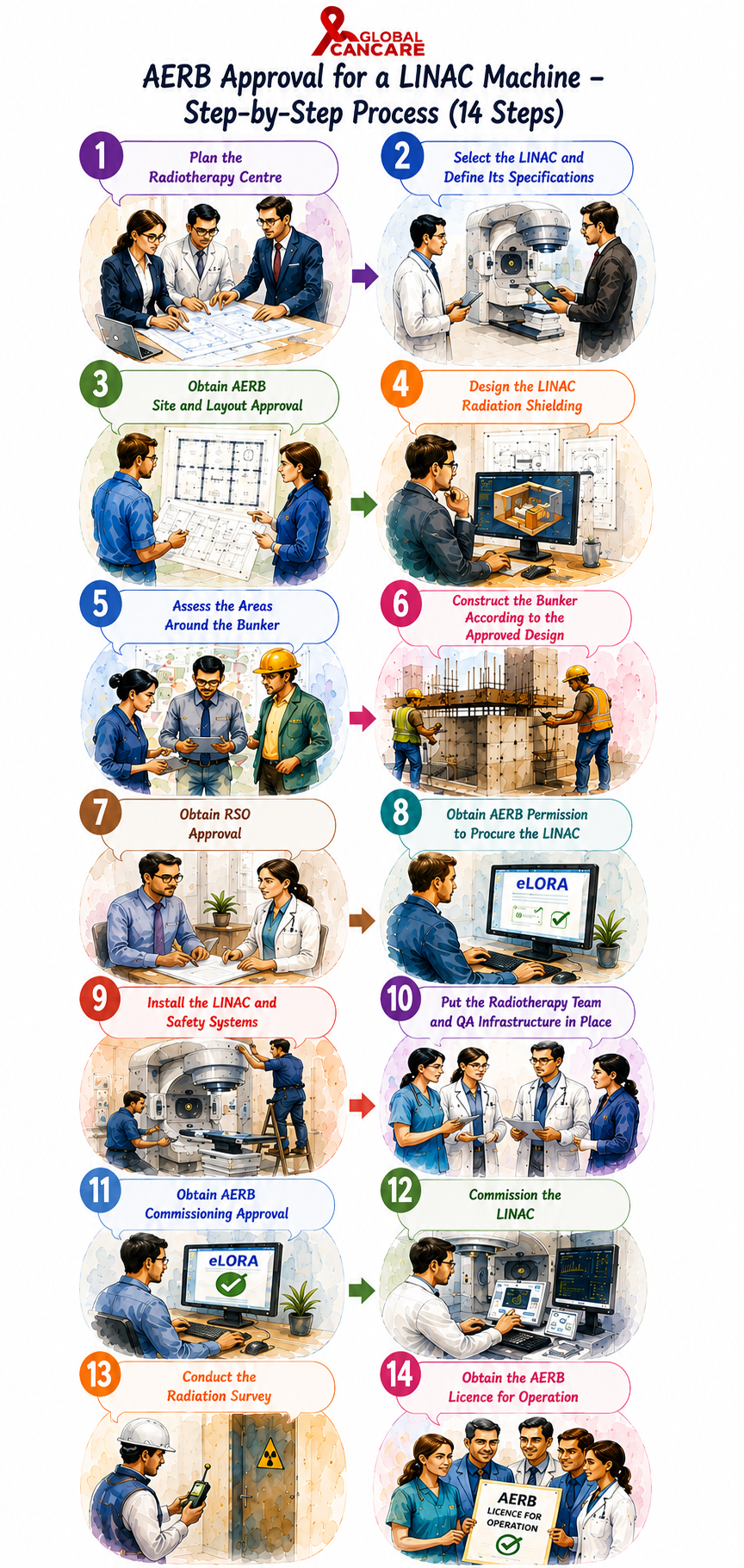
Step 8: Obtain AERB Permission to Procure the LINAC
Once the applicable regulatory requirements are fulfilled, obtain permission to procure the proposed LINAC. Equipment selection should consider clinical requirements as well as regulatory, QA and infrastructure needs.
Step 9: Install the LINAC and Safety Systems
Install the machine along with interlocks, access controls, warning systems, emergency shutdown systems and other required safety features.
Step 10: Put the Radiotherapy Team and QA Infrastructure in Place
Ensure that the medical physicists, radiation therapists, technicians, RSO and other required personnel are available. TLD badges, dosimetry equipment and QA tools should also be ready for commissioning.
Step 11: Obtain AERB Commissioning Approval
AERB commissioning approval is required before energising the LINAC for radiation. Receiving the machine does not mean that the beam can immediately be switched on.
Step 12: Commission the LINAC
Commission the installed system and establish baseline performance. Depending on the machine and intended treatment techniques, this can include beam output, energy, profiles, mechanical accuracy, imaging, treatment-planning interfaces, interlocks and IMRT/VMAT/IGRT-related checks.
Step 13: Conduct the Radiation Survey
Measure radiation levels around the completed installation and submit the required survey documentation. The survey verifies the actual radiation environment against the shielding and safety assessment.
Step 14: Obtain the AERB Licence for Operation
After completing the applicable commissioning, radiation survey and QA requirements, apply for the licence for operation. Routine patient treatment can begin only after the required operating licence is obtained.
How Long Does AERB Approval for a LINAC Machine Take?
Obtaining complete AERB approval and an operational licence for a LINAC radiotherapy machine typically takes around 3–6 months, although the actual duration can vary depending on documentation, shielding compliance, project readiness and RSO approval. The process is managed through AERB’s eLORA Portal, which is used for submitting applications and obtaining the required regulatory consents.
The process generally moves through several stages:
Institution Registration & eLORA Setup: approximately 3–7 working days.
Site & Layout Approval: approximately 30–45 days. This must be completed before proceeding with the relevant procurement stage.
RSO Approval/Certification: approximately 15–30 days. An appropriately qualified RSO must be approved before the facility can proceed with equipment procurement.
Procurement & Installation Permission: approximately 15–30 days, depending on the equipment and documentation.
Final QA & Licence to Operate: approximately 30–60 days after installation, including required testing, radiation surveys and submission of compliance documentation.
For example, a new hospital starting from the planning stage would first need to register on eLORA, prepare the LINAC bunker layout and obtain site approval before moving ahead with procurement. A hospital that has already constructed the bunker but has not secured the required layout approval may need to address the regulatory gap before proceeding further. Similarly, if a 6 MV LINAC has already been installed, the project would typically move toward commissioning, QA and the remaining requirements for obtaining the operating licence.
AERB’s published process confirms that site and layout approval, RSO approval and equipment procurement permission are distinct regulatory steps, while operation requires fulfilment of the applicable safety and licensing requirements.
Handling AERB Approval, LINAC Installation and Radiotherapy Centre Setup Alone Can Be Challenging
Setting up a radiotherapy centre with AERB approval and LINAC installation alone is very hard. It involves strict regulatory compliance, heavy shielding design, precise radiation safety protocols, and complex engineering coordination. Doing it by yourself risks costly delays and safety non-compliance.
Key Challenges in Setup
AERB Licensing: Getting layout approval, radiation safety certificates, and final operation licenses from the Atomic Energy Regulatory Board takes rigorous documentation.
Vault Shielding: Designing concrete thickness and maze layouts to block radiation requires specialized medical physicists.
Rigging and Delivery: Moving a multi-tonne LINAC needs heavy cranes, reinforced floors, and precise alignment.
Quality Assurance: Commissioning baseline beam data and safety interlocks takes weeks of testing.
How Global CanCare Helps Bring the Pieces Together
Global CanCare is an integrated oncology partner, bringing together radiotherapy technology, cancer infrastructure, radiation protection and specialist workforce capabilities. Its stated approach supports healthcare providers from facility planning through clinical operations and workforce development.
For a LINAC for radiation therapy project, this can include support across:
Radiotherapy centre planning
LINAC technology selection
Radiotherapy bunker design and construction
Radiation shielding solutions
AERB-oriented project coordination
LINAC installation
Commissioning support
Radiotherapy equipment integration
Global CanCare's ecosystem includes The Bunker Company for radiotherapy bunker design and build, Global Radiation Shielding for engineered shielding systems, Global Radiotherapy Solutions for radiotherapy technology and RT People for specialist radiotherapy and medical-physics workforce solutions.
Its radiotherapy infrastructure offering also describes customised bunker planning based on machine energy, site conditions and regulatory requirements, with construction coordinated with equipment delivery and commissioning.
From LINAC Planning to Installation and Commissioning
For a hospital establishing a new oncology radiation centre, an integrated approach can simplify coordination between technology, infrastructure and specialist teams.
Instead of separately managing the LINAC supplier, bunker contractor, shielding consultant, technical workforce and project teams, the institution can work with a partner capable of coordinating multiple components of the project.
The regulatory authority remains AERB, and all statutory approvals must be obtained through the prescribed regulatory process. Global CanCare's role is to support planning, coordination and implementation around those requirements.
Planning a New LINAC-Based Radiotherapy Centre?
Whether you are setting up a new radiotherapy centre, establishing an oncology radiation centre, expanding an existing cancer hospital or adding a new LINAC machine, the project needs to be planned as an integrated system.
Talk to Global CanCare about your facility.
Global CanCare — Contact Information
General Enquiries: info@globalcancare.com
Head Office – Northern Region (Delhi): +91 8120115666
Western Region (Mumbai): +91 9098793898 |
Southern & Eastern Region (Bangalore/Kolkata): +91 7974667979
Frequently Asked Questions About AERB Approval for LINAC
Is AERB approval mandatory for a LINAC machine in India?
Yes. Medical LINAC installations fall under AERB’s regulatory framework, with applicable approvals and licensing processes managed through eLORA.
How long does AERB approval for a LINAC take?
The complete process typically takes around 3–6 months, depending on documentation, AERB review, RSO approval, shielding compliance and project readiness.
What approvals are required to set up a LINAC?
The process generally includes site and layout approval, RSO approval, procurement permission, commissioning approval, radiation survey and the final operating licence.
Can construction begin before AERB layout approval?
No. The required site and layout approval should be obtained before bunker construction, with the shielding and facility design based on the approved plan.
Can a hospital switch on a LINAC as soon as it is installed?
No. AERB commissioning approval is required before the LINAC is energised for radiation.
How many LINAC machines are there in India?
India has an estimated 600 to 700 operational medical Linear Accelerator (LINAC) machines used for cancer radiation therapy.
What are the AERB guidelines for radiotherapy technologists?
The Atomic Energy Regulatory Board (AERB) guidelines require radiotherapy technologists to have a minimum 10+2 science qualification plus a recognized specialized training program. Technologists must strictly execute patient setups, deliver precise prescribed radiation doses, monitor equipment for faults, and report safety incidents immediately to the Radiological Safety Officer (RSO).
What are the AERB guidelines for radiation protection?
The Atomic Energy Regulatory Board (AERB) guidelines for radiation protection are built on three core principles: Justification (ensuring any radiation practice provides a net benefit), Optimization (keeping exposures as low as reasonably achievable, or ALARA), and Limitation(enforcing strict occupational and public dose limits).
What are the three basic principles of radiation safety?
The three fundamental principles are Justification, Optimisation (ALARA) and Dose Limitation. These form the foundation of radiation-protection practices.
What is Rule 3 of the Atomic Energy (Radiation Protection) Rules?
Rule 3 of the Atomic Energy (Radiation Protection) Rules, 2004 mandates that no person shall manufacture, possess, use, handle, transport, dispose of, import, export, or transfer any radioactive material or radiation-generating equipment without obtaining prior regulatory consent (in the form of a license, authorization, or registration) from the Competent Authority.
How do I check an AERB certificate or approval?
To check an Atomic Energy Regulatory Board (AERB) certificate or approval status, log in to the eLORA Login Page using your registered credentials. Once logged in, navigate to the application status or "My Applications" section to verify license validity, approval details, or type-approved equipment.
Does AERB approval cover the entire hospital building?
No. AERB approval primarily addresses radiation safety and the radiotherapy facility. Other building and statutory approvals remain the responsibility of the institution and relevant authorities.
Can an existing hospital simply add another LINAC to its current approval?
No. A second LINAC requires the applicable regulatory, technical and radiation-safety assessment and approvals for its installation. Existing approval should not automatically be assumed to cover another machine.
What is the 7/10 rule for radiation?
The 7-10 rule of thumb for radiation estimates that for every seven-fold increase in time after a nuclear detonation, the radiation exposure rate from nuclear fallout decreases by a factor of 10. For example, if the dose rate is 100 R/hr at 1 hour, it drops to 10 R/hr at 7 hours.
What is an unsafe level of radiation?
According to the CDC, radiation doses between 1,000 millisieverts (mSv) received all at once become dangerous, causing immediate physical harm like nausea and cell damage. Levels below 100 mSv are generally considered safe, while doses over 4,000 to 8,000 mSv can be fatal.
Safe and Low Levels
Under 10 mSv: Safe background or daily levels; normal dental X-rays are around 0.1 mSv.
10 to 100 mSv: Safe overall, though it may cause a very small increase in lifetime cancer risk.
Where can I find AERB regulations and guidelines?
AERB publishes its Safety Codes, Safety Guides, regulatory requirements and eLORA guidance on its official website, including documents specific to radiotherapy facilities.
Sources and Further Reading
Disclaimer: AERB regulations, eLORA workflows, forms, equipment requirements and technical guidance may be revised. This article is intended for general informational and project-planning purposes and should not replace the latest AERB/eLORA requirements, facility-specific radiation-shielding calculations or advice from qualified medical physicists, radiation-safety professionals and regulatory specialists. For a specific LINAC machine, bunker or radiotherapy-centre project, the applicable requirements should be verified with AERB and the relevant technical professionals before construction, procurement or commissioning.
Planning a Cancer Care project?
Our specialists can scope equipment, shielding, licensing and staffing for your facility.
Talk to our team