
cyclotron, radioisotope production
Medical Cyclotron Decommissioning: AERB Guidelines for Replacing Old Cyclotrons
Planning to replace an ageing medical cyclotron? Learn the AERB decommissioning process, regulatory requirements, and best practices for safely transitioning to a modern cyclotron with minimal downtime.
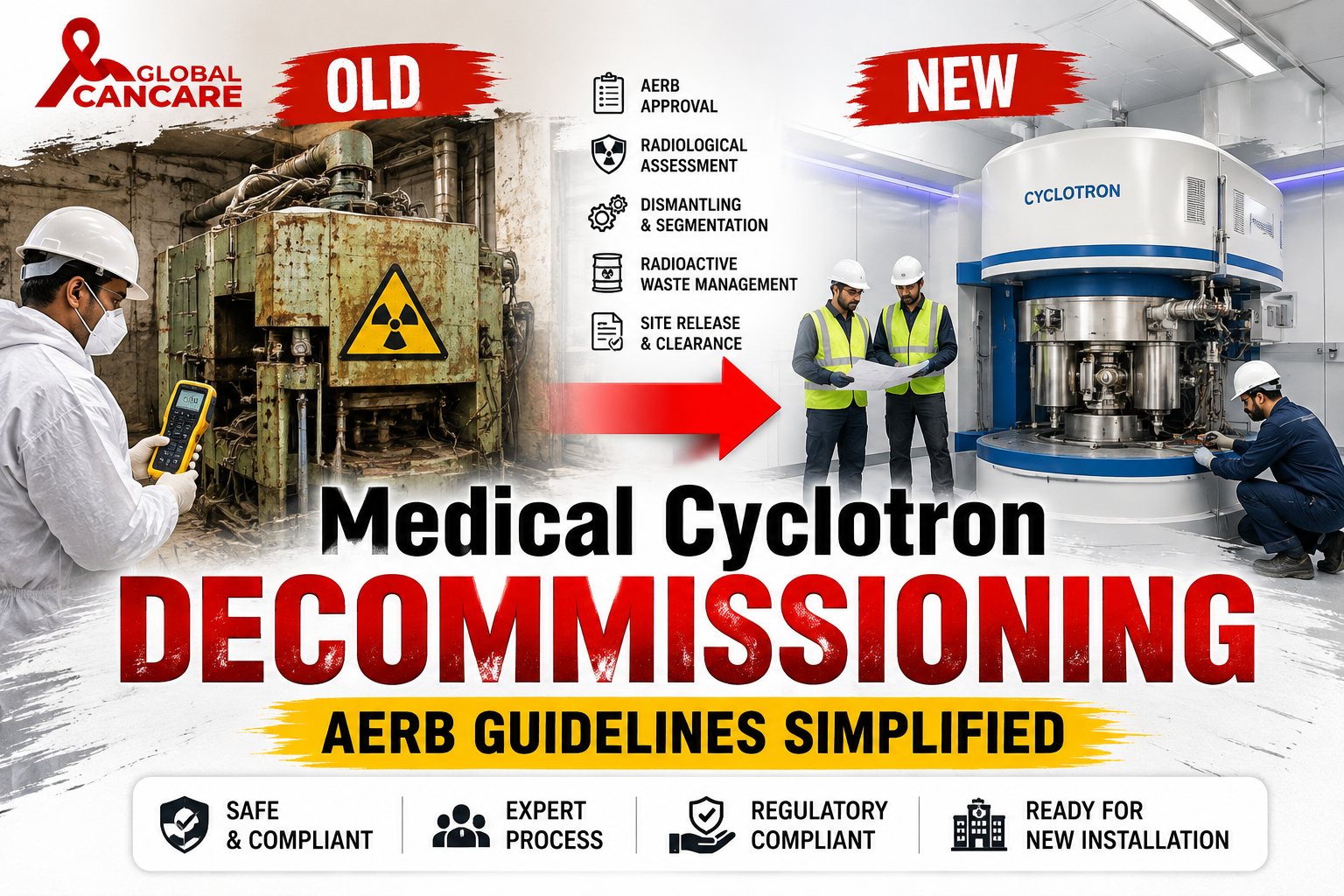
Medical cyclotron decommissioning is no longer just a regulatory requirement. As ageing cyclotrons become more expensive to maintain and less reliable, healthcare providers are increasingly replacing them with modern, energy-efficient systems. The International Atomic Energy Agency (IAEA) also recognizes modernization as a key step in improving operational efficiency and long-term sustainability.
Before a new medical cyclotron can be installed, however, the existing facility must be decommissioned in accordance with the guidelines of the Atomic Energy Regulatory Board (AERB). This process involves regulatory approvals, radiation safety, decontamination, dismantling, radioactive waste management, and final regulatory clearance.
Whether you're planning to replace an ageing cyclotron or bring in next-generation technology, this guide explains the AERB decommissioning process, regulatory requirements, and how Global CanCare supports a safe, compliant, and seamless transition.
What Is Medical Cyclotron Decommissioning?
According to the Atomic Energy Regulatory Board (AERB), medical cyclotron decommissioning is the systematic process of safely retiring a medical cyclotron facility at the end of its useful life or when it is no longer used for its intended purpose.
The objective is to ensure the facility no longer poses a radiological risk before it is repurposed, upgraded, or released for unrestricted use. Throughout the process, protecting workers, the public, and the environment remains the highest priority.
The decommissioning process involves the removal of radioactive materials and sources, decontamination, dismantling, radioactive waste management, final radiation surveys, and regulatory clearance before the facility is released for unrestricted use.
Before decommissioning begins, the entire facility—including the cyclotron—must be assessed for radioactive contamination. Contaminated components are identified, segregated according to their half-lives, and safely managed in accordance with AERB requirements.
Once decommissioning is complete, the facility undergoes a comprehensive radiation survey to verify that dose rates and contamination levels are within the limits prescribed by AERB. Only after regulatory clearance can the facility be safely reused or prepared for the installation of a new medical cyclotron.
Why Replace or Remove an Old Medical Cyclotron?
Medical cyclotron facilities are commonly decommissioned because of ageing, the end of their design life, operational changes, relocation, or other technical reasons, as outlined in ISO 8939:2025.
For hospitals, PET centres, research institutions, and radiopharmaceutical manufacturers, replacing an ageing cyclotron is often driven by operational, technical, and business considerations rather than age alone.
Common reasons for replacement include:
Increasing maintenance and service costs
Obsolete components and limited spare-part availability
Reduced equipment reliability and unplanned downtime
Lower beam performance and isotope production efficiency
Higher electricity consumption
Growing demand for PET imaging and radiopharmaceutical production
Expansion or relocation of nuclear medicine facilities
Upgrading to newer cyclotron technology with improved automation and productivity
Replacing an ageing medical cyclotron is a strategic investment that improves operational efficiency, reduces lifecycle costs, and supports future growth. Before a replacement system can be installed, however, the existing facility must be decommissioned in accordance with AERB guidelines.
AERB Guidelines and Medical Cyclotron Decommissioning Process
Medical cyclotron decommissioning doesn't begin when dismantling starts—it begins much earlier. According to the AERB Safety Code for Medical Cyclotron Facilities (AERB/RF-MED/SC-3, Rev. 1, Sections 4.8.3.1 & 4.8.3.2), facilities should plan for decommissioning during the design stage and obtain regulatory approval before any work begins.
1. Planning and Regulatory Approval
Planning ahead makes future replacement safer and more efficient. For example, designing the vault so the cyclotron can be removed without major demolition can significantly reduce future downtime and costs.
AERB recommends:
Designing the vault for easier cyclotron removal
Making financial provisions for future decommissioning
Providing temporary radioactive waste storage
Managing radioactive waste as per regulations
Maintaining long-term accountability of the licensee
Before decommissioning starts, the licensee must submit a decommissioning plan to AERB (typically through the eLORA portal) and obtain regulatory consent.
2. Medical Cyclotron Decommissioning Process
Once approval is received, the work follows a structured sequence:
Radiation survey of the facility and cyclotron
Removal of radioactive materials and sources
Decontamination and dismantling
Radioactive waste management through an AERB-authorized agency
Final radiation survey and submission of the decommissioning report
If the approved decommissioning plan needs to change during the project, prior approval from AERB must be obtained.
3. Final Survey and Regulatory Clearance
After decommissioning, the Radiation Safety Officer (RSO) conducts a comprehensive radiation survey to verify that dose rates and contamination levels are within AERB limits.
The RSO prepares the decommissioning report, records personnel radiation doses, and submits the documentation to AERB. Once the report is approved, AERB grants final clearance, allowing the facility to be released for unrestricted use or prepared for the installation of a new medical cyclotron. Monitoring records must be maintained for three years by the licensee and the RSO.
The Challenges of Managing Medical Cyclotron Decommissioning Without Expert Support
Replacing or upgrading a medical cyclotron often involves multiple organizations working together. Civil contractors, equipment suppliers, radiation safety professionals, waste management agencies, and regulatory authorities all have different responsibilities, timelines, and dependencies.
Without experienced project coordination, even small delays can affect the overall schedule. For example, a delay in dismantling can postpone the installation of the new cyclotron, while incomplete documentation can hold up regulatory approvals and final handover.
Working with a single project partner helps streamline communication, coordinate every stage of the project, and keep the transition on schedule.
Why Choose Global CanCare for Medical Cyclotron Decommissioning?
Whether you're planning to shut down, remove or replace a medical cyclotron, the process involves much more than removing old equipment. It requires careful planning, regulatory approvals, radiation safety, and seamless coordination to keep your project on schedule.
Global CanCare provides end-to-end support—from AERB approvals and safe decommissioning to installing and commissioning the latest generation of energy-efficient medical cyclotrons with higher automation, improved reliability, and greater radioisotope production.
Our services include:
AERB approvals and regulatory support
Medical cyclotron decommissioning
Radioactive waste management
Installation and commissioning of new cyclotrons
Upgrade planning with minimal operational downtime
Whether your goal is to modernize an existing facility or build new cyclotron capabilities, Global CanCare helps you transition safely, efficiently, and in full compliance with AERB requirements.
Looking to Decommission or Upgrade Your Medical Cyclotron?
From AERB approvals and safe decommissioning to installing the latest generation of energy-efficient medical cyclotrons, Global CanCare delivers end-to-end project support tailored to your facility.
Contact our team to discuss your project, request a consultation, or explore the right cyclotron solution for your organization.
Head Office (Delhi, India)
📧 info@globalcancare.com
📞 +91 81201 15666
Regional Offices
Western India (Mumbai)
📞 +91 90987 93898
Southern & Eastern India (Bengaluru & Kolkata)
📞 +91 79746 67979
For general enquiries, email info@globalcancare.com or visit our Contact Us page to connect with the Global CanCare team nearest you.
Frequently Asked Questions (FAQs)
How long does medical cyclotron decommissioning take?
Most projects take 2–6 months, depending on regulatory approvals, radiation levels, waste disposal requirements, and whether a replacement cyclotron is being installed.
How much does decommissioning cost?
Costs vary based on factors such as the cyclotron model, level of activation, dismantling complexity, radioactive waste disposal, transportation, and site restoration. A site assessment is needed to provide an accurate quotation.
What are the benefits of replacing an ageing medical cyclotron?
A new cyclotron can deliver higher radioisotope production, lower maintenance costs, improved reliability, better energy efficiency, greater automation, and reduced downtime.
Can the existing cyclotron vault be reused?
Yes. In many cases, the existing vault can be reused after decommissioning, radiation clearance, and any required structural modifications for the new cyclotron.
Who is responsible for obtaining AERB approvals?
The facility licensee is responsible for regulatory compliance, although experienced project partners can prepare documentation, coordinate submissions, and support the approval process.
What radioactive waste is generated during decommissioning?
Typical waste includes activated cyclotron components, contaminated piping, shielding materials, filters, and other radioactive materials, all of which must be managed according to AERB requirements.
Can a hospital continue operating during cyclotron replacement?
Often, yes. While the cyclotron facility itself may be temporarily unavailable, other hospital services can usually continue if the project is properly planned.
How can downtime be reduced during cyclotron replacement?
Early planning, obtaining approvals in advance, coordinating decommissioning with new equipment delivery, and working with a single project partner can significantly reduce downtime.
Can decommissioning and installation be handled by one company?
Yes. An end-to-end provider can manage AERB approvals, decommissioning, waste management, new cyclotron installation, commissioning, and project coordination, reducing delays and simplifying communication.
When should a medical cyclotron be replaced?
Replacement should be considered when maintenance costs increase, spare parts become difficult to source, equipment reliability declines, isotope demand grows, or newer technology offers better efficiency and productivity.
Planning a Cancer Care project?
Our specialists can scope equipment, shielding, licensing and staffing for your facility.
Talk to our team