
UK–India Free Trade Agreement
The UK–India Free Trade Agreement: A Game Changer for Healthcare Partnerships
The UK–India Free Trade Agreement & Affordable Radiotherapy Machines The UK –India Free Trade Agreement (FTA) represents more than just an economic milestone; it is also a transformative opportunity for healthcare collaboration. With cancer cases rising year after year, both…
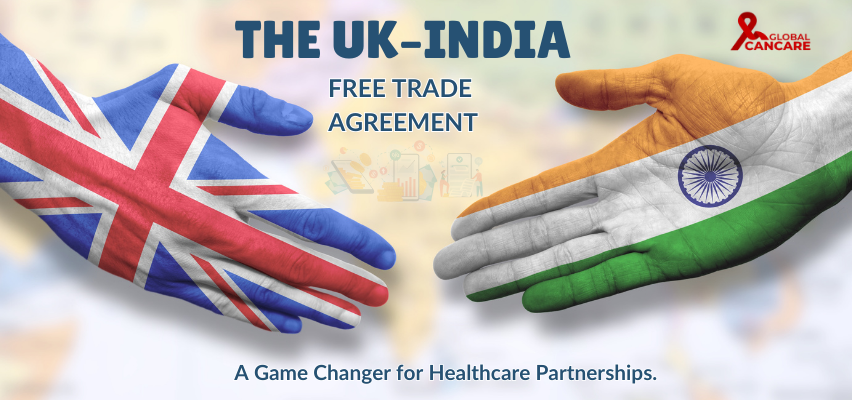
The UK–India Free Trade Agreement & Affordable Radiotherapy Machines
The UK–India Free Trade Agreement (FTA) represents more than just an economic milestone; it is also a transformative opportunity for healthcare collaboration. With cancer cases rising year after year, both nations face growing demand for modern cancer treatment technologies. One of the most pressing needs is access to affordable radiotherapy machines, particularly the LINAC machine (linear accelerator linac) which has become the gold standard in radiation oncology.

At the forefront of this healthcare transformation is Global Cancare Pvt Ltd, the exclusive distributor of Panacea Medical Technologies Pvt Ltd. Together, they are enabling affordable, scalable, and internationally certified radiotherapy solutions that can directly benefit the UK’s National Health Service (NHS) under the new trade agreement.
India’s Approach: Expanding Access with Affordable Radiotherapy Machines
India, with its much larger cancer burden, has taken a different approach. Faced with millions of cancer cases rising annually, India has developed models that highlight scalability and affordability—without compromising quality.
At the core of this transformation are linear accelerator linacs produced by Panacea Medical Technologies Pvt Ltd and distributed globally by Global Cancare Pvt Ltd. These CE- and FDA-certified radiotherapy machines deliver world-class precision and safety at a fraction of the cost of brands like Elekta and Varian. By combining cost efficiency with innovation, India has proven that expanding access is possible—even under resource constraints.
Global Cancare Pvt Ltd: Building Healthcare Bridges
Global Cancare Pvt Ltd plays a pivotal role in bringing Panacea’s innovations to global markets, including the UK. More than just a distributor, the company offers turnkey solutions that empower hospitals and healthcare providers to expand their cancer treatment capacity.
Global Cancare’s Key Offerings:
- Standalone Radiation Centres: Quick-to-deploy cancer care facilities equipped with modern LINAC machines.
- Hospital Partnerships: Profit-sharing and operational tie-ups that reduce financial burdens for hospitals.
- Infrastructure Modernisation: Upgrading outdated cobalt bunkers into fully functional linear accelerator linac facilities.
- Comprehensive Ecosystems: Integration of brachytherapy, imaging, and diagnostic equipment alongside radiotherapy.
How the UK–India Free Trade Agreement Strengthens Cancer Care
The UK–India Free Trade Agreement provides multiple benefits for the healthcare sector:
- Zero Import Duty – Affordable radiotherapy machines can enter the UK market at lower costs, reducing the burden on NHS budgets.
- Accelerated Access – Faster approvals and streamlined trade policies mean hospitals can upgrade technology without delays.
- Innovation Sharing – Partnerships between Indian and UK institutions can drive research, clinical trials, and training programs.
- Healthcare Equity – Affordable LINAC machines ensure treatment is accessible not just in major UK hubs but also in underserved regions.
This agreement is not just about trade—it is about strengthening the ability of both countries to respond to rising cancer cases with modern, scalable, and affordable technology.
How the UK–India Free Trade Agreement Strengthens Cancer Care
India’s experience offers several lessons that the UK can adopt to improve radiotherapy access within the NHS:
- Affordable Technology
- Lower-cost, high-quality radiotherapy machines make expansion financially feasible.
- Panacea’s linear accelerator linac is proof that affordability doesn’t mean compromise.
- Standalone Radiation Centres
- India has invested in standalone centres dedicated solely to radiotherapy.
- These centres are quicker to establish and reduce pressure on major NHS hospitals.
- Repurposing Infrastructure
- Old cobalt bunkers in India are being transformed into modern radiotherapy facilities.
- A similar approach in the UK could accelerate NHS expansion without waiting for new builds.
- Old cobalt bunkers in India are being transformed into modern radiotherapy facilities.
- Public-Private Collaboration
- India leverages partnerships with private players like Global Cancare to deliver services.
- The UK can adopt this model to scale faster and meet patient demand more effectively.
- India leverages partnerships with private players like Global Cancare to deliver services.
UK–India Free Trade Agreement: A New Era for Cancer Care
The combination of Panacea’s innovation and Global CanCare’s international distribution expertise, backed by the UK–India Free Trade Agreement, marks the beginning of a new era for cancer care. With access to affordable radiotherapy machines such as the LINAC machine (linear accelerator linac), the NHS and other healthcare systems across the UK can expand treatment capacity, reduce waiting times, and improve outcomes for patients.
As cancer cases rising continue to challenge healthcare systems, partnerships like these will prove essential in ensuring that advanced care is not a privilege but a universal right.
Contact Us:
- Email: info@globalcancare.com
- Website: globalcancare.com
- Call: +91 8120115666
Planning a Cancer Care project?
Our specialists can scope equipment, shielding, licensing and staffing for your facility.
Talk to our team