
Cyclotron
What Is a Cyclotron and How Does It Power Nuclear Medicine?
What is a cyclotron and how does it power nuclear medicine? Explore cyclotron for radiopharmacy, PET tracer production in India, and Global CanCare's radiopharmaceutical ecosystem.
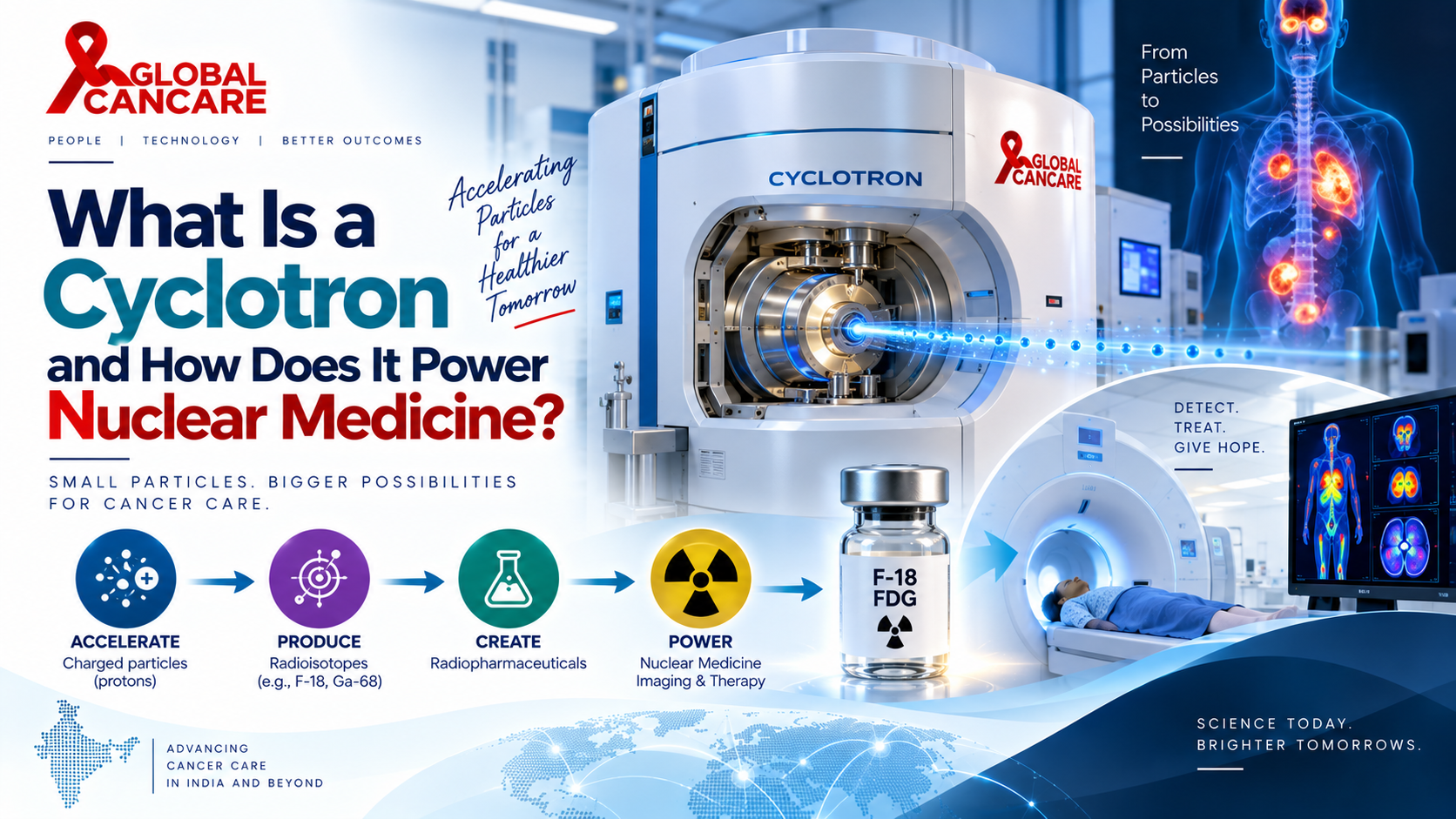
If you search for “what is cyclotron,” the basic physics definition is straightforward. In healthcare, however, a cyclotron represents something much bigger. It can serve as the starting point of a specialised ecosystem connecting radioisotope production, radiopharmacy, PET imaging, nuclear medicine, research, and precision healthcare.
Definition: What Is a Cyclotron?
A cyclotron is a particle accelerator that uses electromagnetic fields to accelerate charged particles to high energies. In healthcare, a cyclotron for radiopharmacy can produce selected short-lived radioactive isotopes that are processed into radiopharmaceuticals and PET tracers for medical imaging and research.
This is why Global CanCare Pvt. Ltd. views cyclotron infrastructure as more than an equipment installation. Through its Global Radiopharmaceutical Network, the company is working toward an ecosystem that connects technology, specialised infrastructure, expertise, research, and healthcare partnerships.
Our Opinion: the real value of a medical cyclotron is not the accelerator alone. Its value comes from how effectively it is connected to radiopharmacy, nuclear medicine, research, and clinical care.
What Is Nuclear Medicine and Why Does It Need Radioisotopes?
Before answering how a cyclotron works, it is important to understand what is nuclear medicine. Nuclear medicine is a medical specialty that uses small amounts of radioactive substances, known as radiopharmaceuticals, to study biological processes inside the body and, for selected applications, deliver targeted treatment.
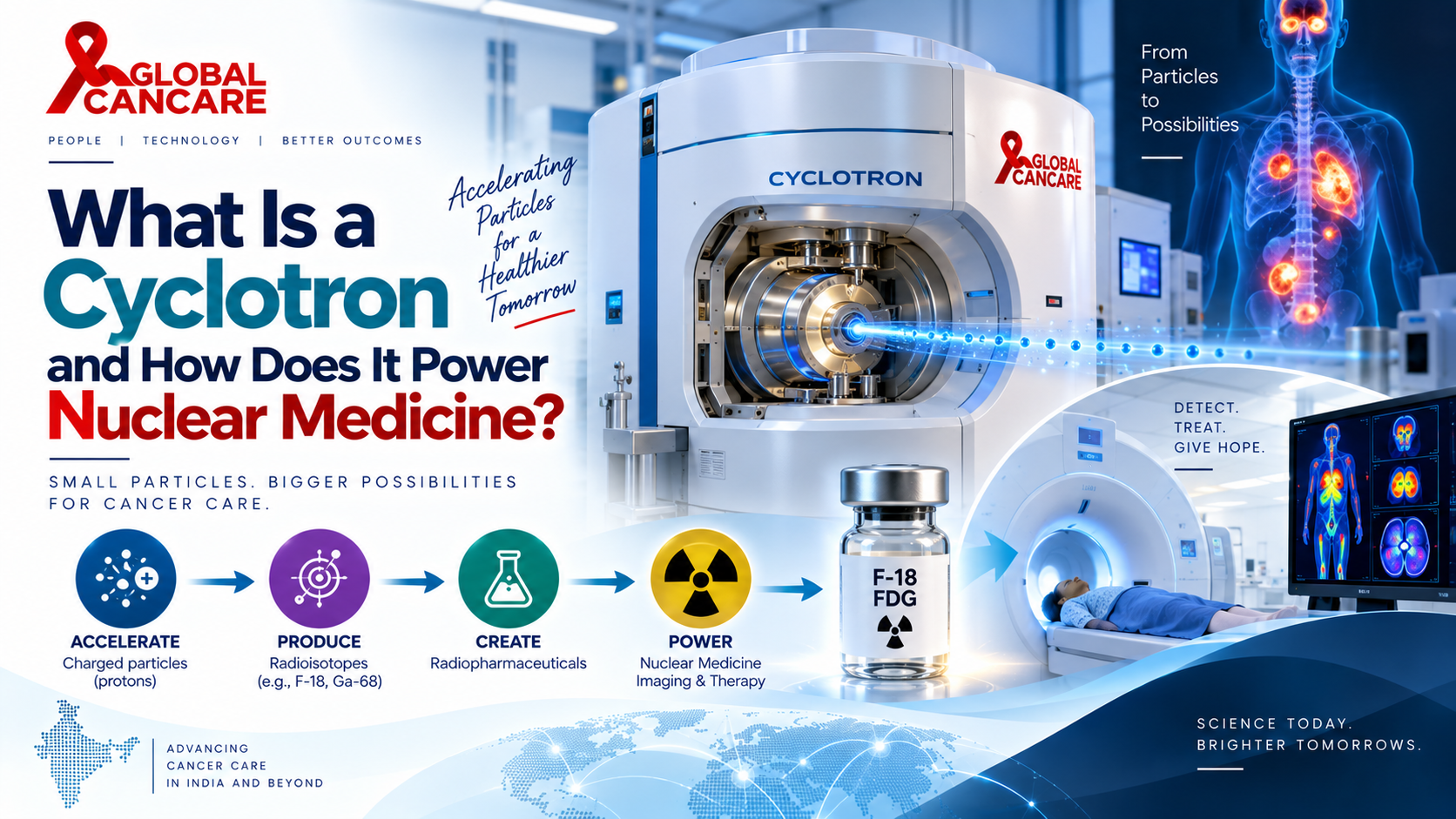
Unlike imaging methods that primarily show anatomy, nuclear medicine can provide information about how tissues and organs function. Depending on the application, it can support cancer detection and staging, treatment-response assessment, cardiac imaging, neurological investigations, and selected targeted radionuclide therapies.
PET, or positron emission tomography, is one of the most recognised nuclear medicine technologies. PET relies on suitable radioactive tracers to identify specific biological activity, making reliable access to appropriate radioisotopes an important part of the overall system.
What Is a Cyclotron in Nuclear Medicine?
In nuclear medicine, a cyclotron can be described as a radioisotope production engine for selected medical applications. It accelerates charged particles and directs them toward a target material. A nuclear reaction can then produce a desired radioactive isotope.
In simplified terms, the process follows this pathway:
Cyclotron → Radioisotope → Radiochemistry → Radiopharmaceutical → PET Imaging
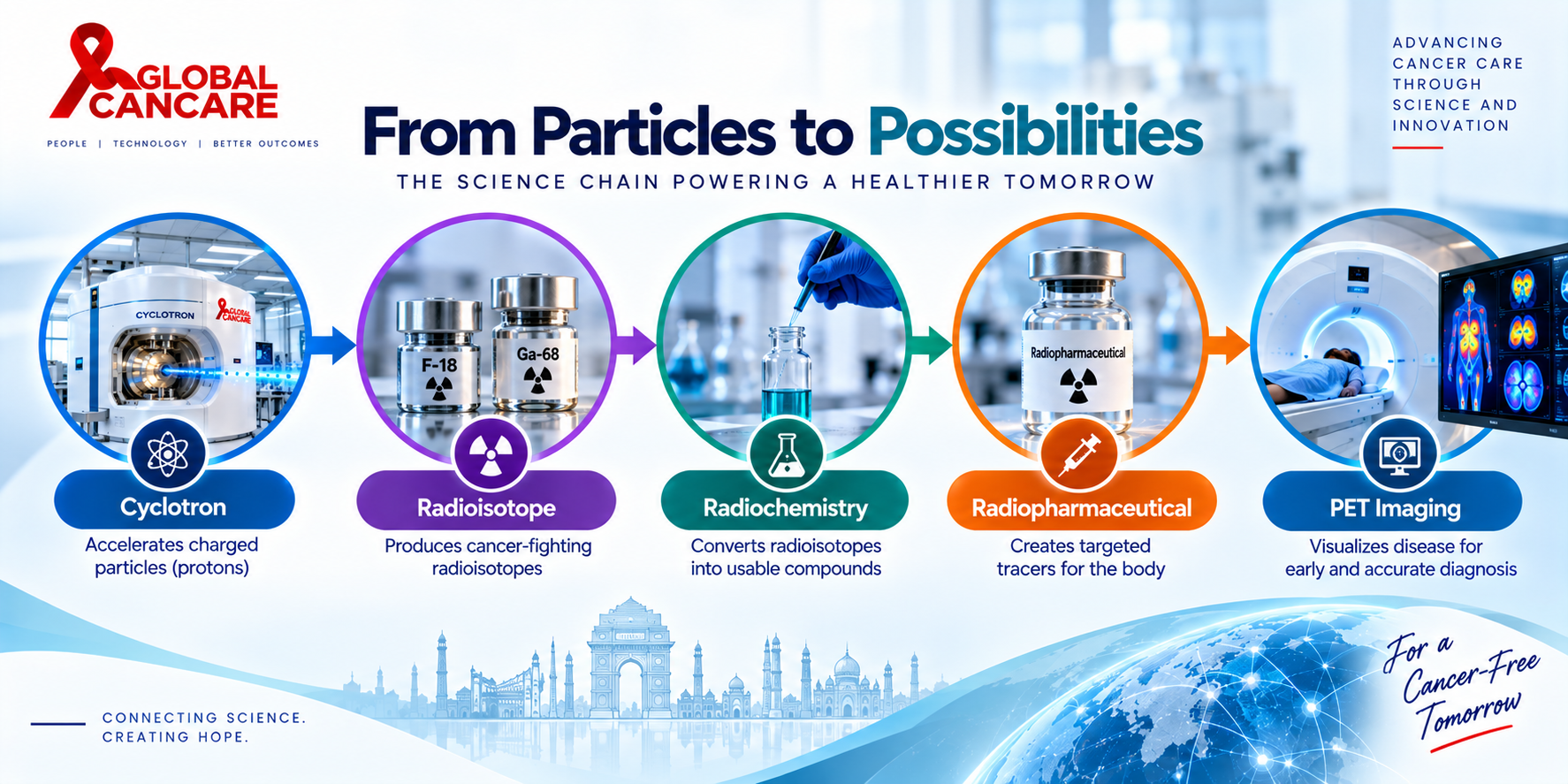
Although this sequence looks simple, the infrastructure supporting it is highly specialised. A medical cyclotron project may involve radiation shielding, target systems, hot cells, radiochemistry facilities, quality-control systems, ventilation, utilities, radiation monitoring, regulatory requirements, trained personnel, and ongoing technical maintenance.
This is precisely why Global CanCare approaches cyclotron development from an ecosystem perspective rather than an equipment-only perspective.
How Does a Cyclotron Power Nuclear Medicine?
One of the most important contributions of a cyclotron is the production of selected radionuclides with relatively short physical half-lives. Depending on the cyclotron configuration and target material, medical facilities can produce radionuclides such as fluorine-18, carbon-11, nitrogen-13, and oxygen-15 for appropriate applications.
Fluorine-18 is particularly important in PET imaging because it can be incorporated into fluorodeoxyglucose (FDG), a widely used PET radiopharmaceutical. Once produced, the radioisotope must be processed and prepared within a carefully controlled timeframe because radioactive materials continuously decay.
This leads to an important insight that is sometimes overlooked when discussing cyclotrons: radiopharmaceutical medicine is also a time-sensitive supply-chain challenge. Production, radiochemistry, quality control, transportation, and clinical use must be coordinated efficiently.
For healthcare planners, therefore, installing a cyclotron without considering the surrounding radiopharmacy and clinical network can limit the value of the investment.
What Is a Cyclotron for Radiopharmacy?
A cyclotron for radiopharmacy is one component of a specialised environment in which selected radioisotopes are produced and subsequently processed into radiopharmaceuticals. The complete system can include the cyclotron, target systems, hot cells, radiochemistry equipment, quality-control laboratories, medical physics, radiation protection, logistics, and PET imaging infrastructure.
Component | Primary Role |
|---|---|
Cyclotron | Produces selected medical radioisotopes |
Target System | Provides material for the nuclear reaction |
Hot Cells | Enables controlled radioactive-material handling |
Radiochemistry | Processes radioisotopes into radiopharmaceuticals |
Quality Control | Evaluates product quality and suitability |
Medical Physics | Supports radiation-related technical requirements |
PET/CT | Uses appropriate tracers for diagnostic imaging |
Logistics | Supports time-sensitive distribution |
Specialised Personnel | Operate and manage the complete workflow |
This illustrates why cyclotron projects should be planned as integrated radiopharmaceutical systems, rather than as isolated equipment purchases.
Global CanCare's capabilities across cyclotrons, nuclear medicine, radiopharmaceuticals, medical physics, medical imaging, CGMP laboratories, clinical research, oncology, and turnkey healthcare infrastructure provide a broader foundation for this type of integrated planning.
PET Tracer Production India: Where Is the Opportunity?
The growing interest in PET tracer production India reflects a wider opportunity for the country's nuclear medicine ecosystem. PET imaging depends on access to suitable radiopharmaceuticals, and some of the radionuclides used in PET have short half-lives. This makes production, processing, quality control, and distribution particularly important.
A typical workflow can be represented as:
Radioisotope Production → Radiochemistry → Quality Control → Distribution → PET Imaging
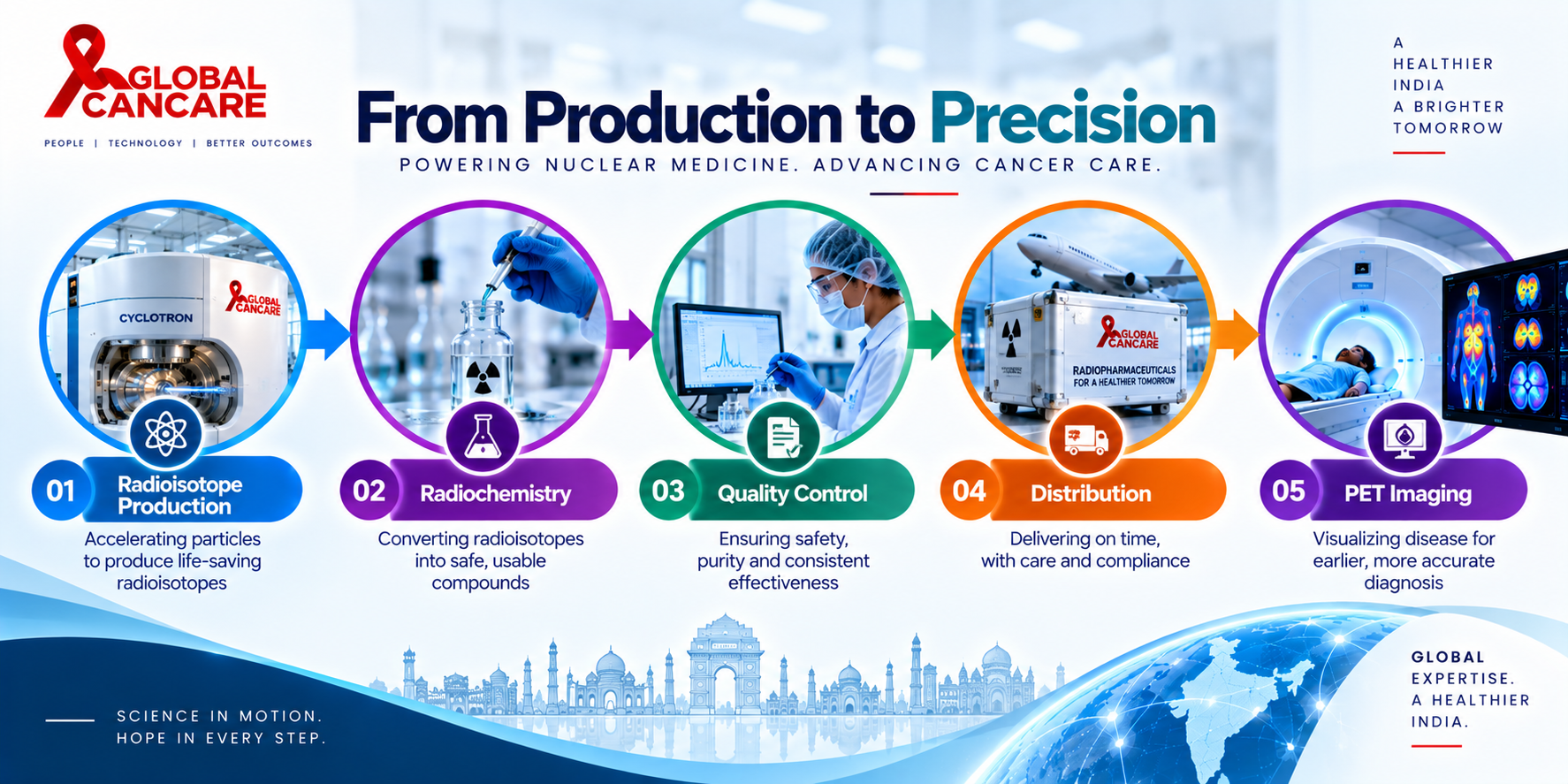
India has the opportunity to strengthen this chain through scientific expertise, specialised manufacturing, radiopharmacy infrastructure, research partnerships, and expanding nuclear medicine services.
However, the opportunity should be viewed beyond simply increasing the number of PET facilities. India's larger strategic opportunity is to develop a connected radiopharmaceutical ecosystem that can serve hospitals, research institutions, and future precision-medicine applications.
This is the thinking behind Global CanCare's Global Radiopharmaceutical Network.
Global Radiopharmaceutical Network: Global CanCare's Integrated Vision
Radiopharmaceutical healthcare depends on multiple capabilities working together. Radioisotope production is only the beginning. The isotope must move through controlled radiochemistry and quality processes before reaching the clinical environment, while nuclear medicine teams, medical physicists, researchers, and healthcare institutions form the downstream network.
Global CanCare's Global Radiopharmaceutical Network is built around this ecosystem concept. It brings together areas including cyclotron infrastructure, radiopharmacy, radiopharmaceuticals, nuclear medicine, medical physics, research, CGMP laboratories, specialised healthcare infrastructure, and hospital partnerships.

This broader approach creates a significant distinction for Global CanCare. The company is not looking at a cyclotron simply as a machine that needs to be installed. It is looking at the healthcare network that needs to function around that machine.
Global CanCare's wider healthcare capabilities also include radiotherapy, medical imaging, clinical research, AI imaging, cell and gene therapy, oncology infrastructure, project management, installation, commissioning, and turnkey healthcare solutions.
The brand's strategic proposition is therefore clear: connect medical technology with the infrastructure, expertise, and partnerships required to make that technology clinically useful and operationally sustainable.
Frequently Asked Questions
What is a cyclotron?
A cyclotron is a particle accelerator that uses electromagnetic fields to accelerate charged particles. In healthcare, it can produce selected radioactive isotopes used in radiopharmaceuticals, PET imaging, research, and other medical applications.
What is nuclear medicine?
Nuclear medicine is a medical specialty that uses radioactive substances called radiopharmaceuticals to examine biological processes in the body and, for selected applications, provide targeted radionuclide treatment.
What is a cyclotron used for in nuclear medicine?
A medical cyclotron can produce selected short-lived radionuclides that are subsequently processed into radiopharmaceuticals for PET and other appropriate medical or research applications.
What is a cyclotron for radiopharmacy?
It is a cyclotron integrated into a specialised radiopharmacy environment where selected radioisotopes can be produced, processed, quality-tested, and prepared for appropriate clinical or research use.
Why is PET tracer production India becoming important?
PET tracers are essential for PET imaging, and some contain short-lived radionuclides. Developing local or regional production capabilities can support availability, research, and the expansion of PET-based healthcare, subject to appropriate infrastructure and regulatory requirements.
Does every nuclear medicine centre need a cyclotron?
No. The requirement depends on the centre's clinical services, isotope requirements, patient volume, location, supply arrangements, research objectives, and applicable regulations.
What is Global CanCare's Global Radiopharmaceutical Network?
It is Global CanCare's ecosystem-oriented approach to connecting cyclotrons, radiopharmaceuticals, radiopharmacy, nuclear medicine, medical physics, research, CGMP laboratories, specialised infrastructure, and healthcare partners.
How does Global CanCare support cyclotron and radiopharmaceutical projects?
Global CanCare brings capabilities across cyclotrons, nuclear medicine, radiopharmaceuticals, medical physics, medical imaging, clinical research, CGMP laboratories, project management, installation, commissioning, and turnkey healthcare infrastructure, enabling an integrated approach to specialised healthcare projects.
Conclusion
So, what is a cyclotron? Technically, it is a particle accelerator. In modern healthcare, however, it can be the first link in a much larger chain connecting radioisotope production, radiopharmacy, PET tracer production, nuclear medicine, research, and precision medicine.
For India, the opportunity is particularly significant. The goal should not simply be to install more cyclotrons, but to develop reliable, connected, quality-focused radiopharmaceutical ecosystems that can support hospitals, researchers, and future nuclear medicine applications.
That is the strategic thinking behind Global CanCare's Global Radiopharmaceutical Network.
Global CanCare is building an ecosystem rather than simply supplying equipment—connecting cyclotrons, radiopharmaceuticals, nuclear medicine, medical physics, research, and healthcare infrastructure to help shape the next generation of precision medicine.
Authoritative Sources
For external references and factual validation, these sources are recommended:
International Atomic Energy Agency – Cyclotrons: IAEA – Cyclotrons
International Atomic Energy Agency – Nuclear Medicine: IAEA – Nuclear Medicine
International Atomic Energy Agency – Radiopharmaceuticals: IAEA – Radiopharmaceuticals
IAEA – Human Health: IAEA Human Health
Society of Nuclear Medicine and Molecular Imaging: SNMMI
European Association of Nuclear Medicine: EANM
National Cancer Institute – PET Scans: NCI – PET Scans
Planning a Cancer Care project?
Our specialists can scope equipment, shielding, licensing and staffing for your facility.
Talk to our team