
Cell & Gene Therapy
Cell & Gene Therapy Infrastructure: What Hospitals Need Before Launching a CGT Program
Explore cell and gene therapy infrastructure India hospitals need, including CGT facility requirements, clinical areas, processing, cryogenic storage, quality, safety, and compliance.
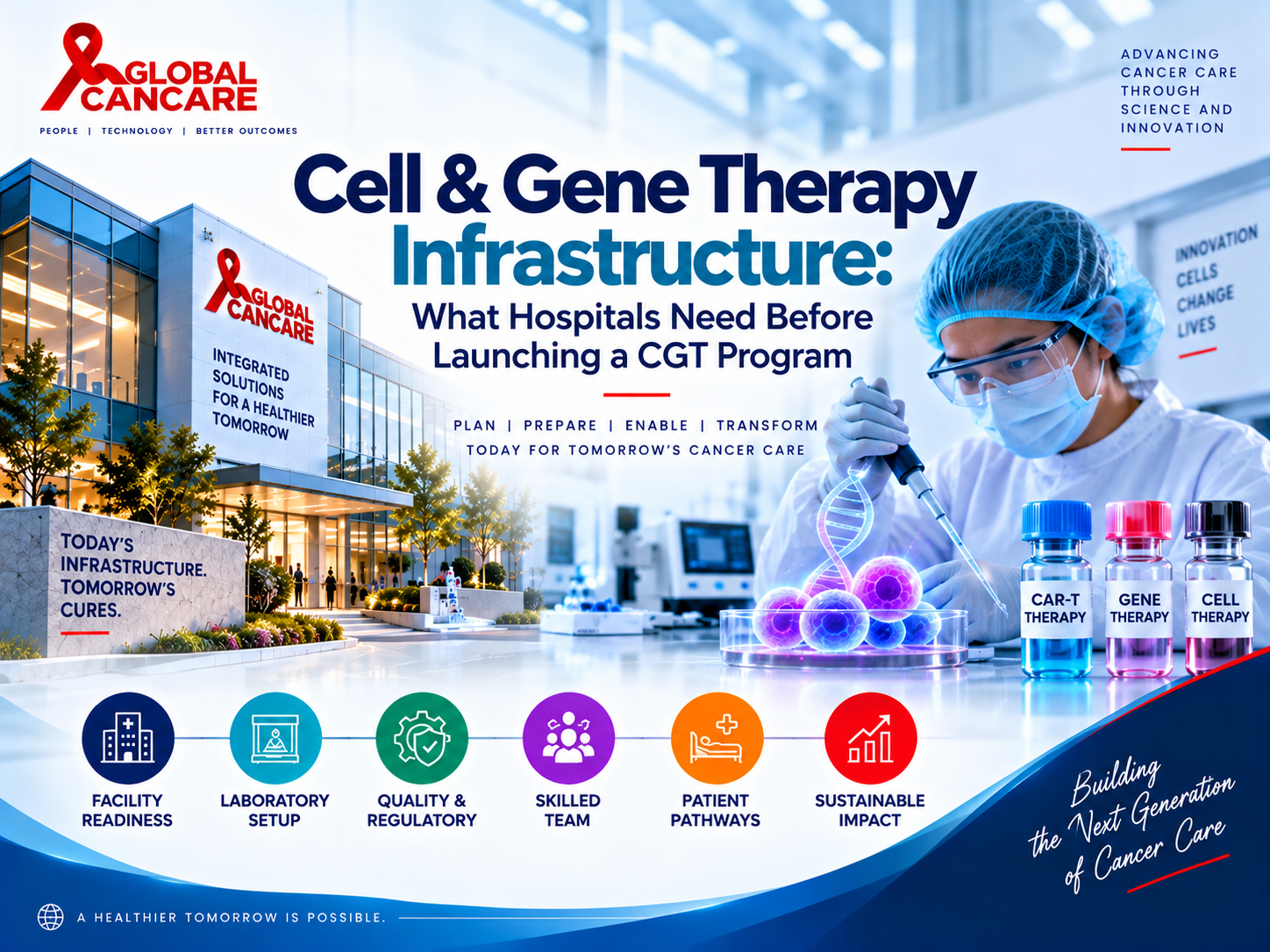
Cell and gene therapy is moving advanced medicine from the laboratory toward real patient care. These therapies can use living cells or genetic approaches to address diseases that may be difficult to treat with conventional medicines.
However, launching a gene and cell therapy program is a major infrastructure decision. Hospitals need to connect clinical care, laboratory operations, quality management, storage, logistics, safety, and specialised teams into one controlled system.
For organisations evaluating cell and gene therapy infrastructure in India, the most important question is not simply, What equipment should we buy? It is, What complete infrastructure will allow the program to operate safely, efficiently, and sustainably?
Global CanCare Pvt. Ltd. takes this integrated view of Cell & Gene Therapy infrastructure, helping healthcare organisations plan advanced facilities around the complete therapy journey.
Quick Answer: What Does a Hospital Need to Start a Cell and Gene Therapy Program?
A hospital planning a cell and gene therapy program needs more than a treatment room. Depending on the therapy and operating model, it may require specialised clinical areas, controlled environments, cell-processing facilities, cryogenic storage, quality systems, traceability, biosafety controls, trained professionals, reliable logistics, and regulatory support. The exact CGT facility requirements should be defined according to the therapy, patient pathway, processing activities, and future expansion plans.
10 Essential Requirements for Cell & Gene Therapy Infrastructure
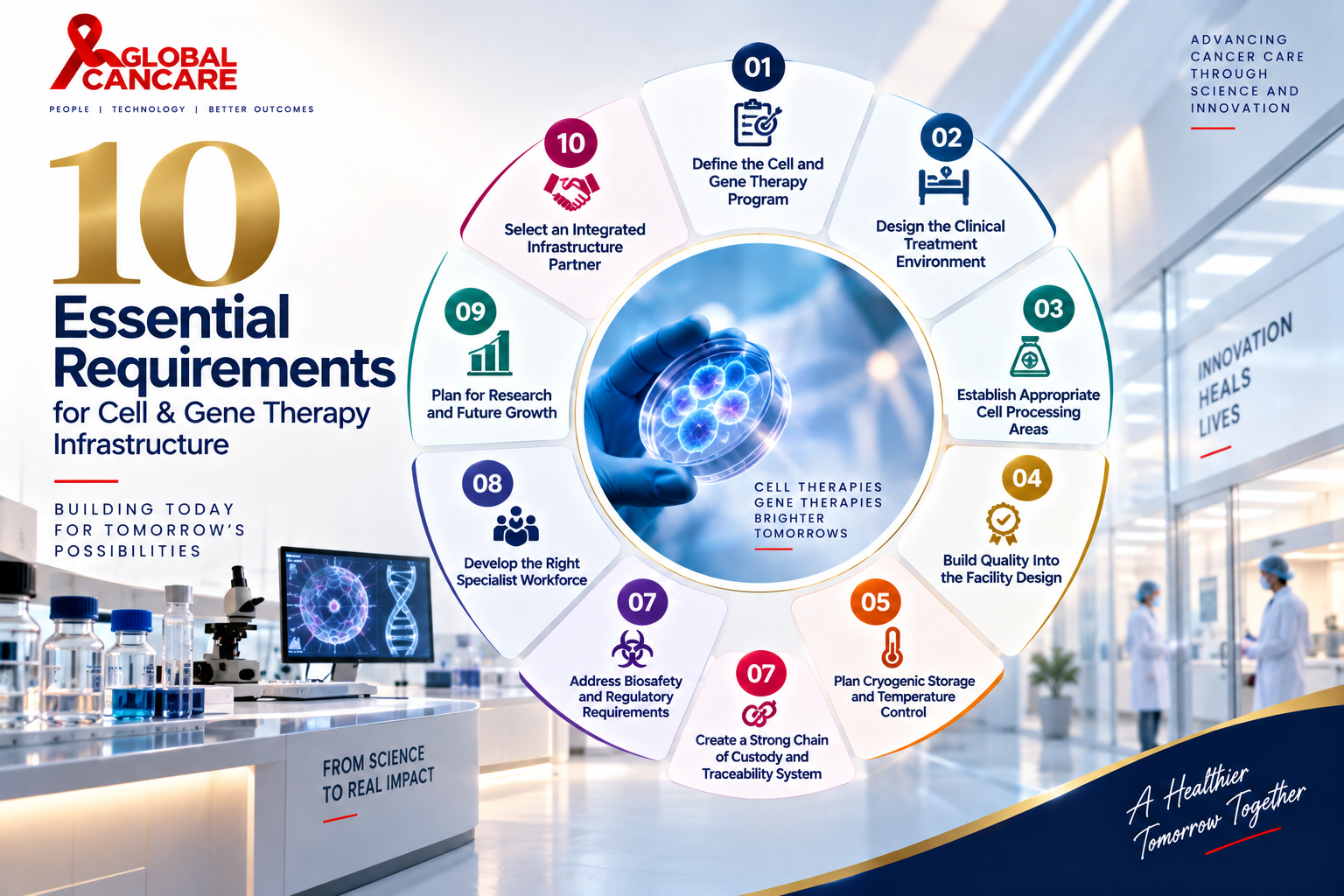
1. Define the Cell and Gene Therapy Program
The first requirement is a clear definition of the program itself.
A hospital may only administer an approved therapy, or it may collect and process patient cells, participate in clinical trials, or develop more advanced capabilities over time. Each model creates different infrastructure and operational requirements.
The hospital should define the therapies, patient population, processing activities, expected workload, clinical pathway, and future objectives before finalising the facility design.
This planning stage helps prevent a common problem: building a facility first and discovering later that it cannot efficiently support the intended cell and gene therapy workflow.
2. Design the Clinical Treatment Environment
The clinical environment must support patients before, during, and after treatment.
Depending on the therapy, hospitals may need dedicated assessment areas, treatment or infusion rooms, patient observation areas, emergency support, infection-control measures, and appropriate patient and staff movement.
The design should follow the patient's complete journey rather than treating the treatment room as an isolated space. For a successful gene and cell therapy program, clinical infrastructure should work seamlessly with laboratory, pharmacy, storage, and logistics functions.
3. Establish Appropriate Cell Processing Areas
Not every CGT program requires the same level of on-site processing. Where cell collection, preparation, or processing takes place, the facility may require controlled environments, appropriate cleanroom arrangements, specialised equipment, environmental monitoring, validated processes, and contamination-control measures.
The design must be based on the actual therapy and process. There is no single facility model that fits every form of cell and gene therapy.
This makes process mapping one of the most important CGT facility requirements during the early design stage.
4. Build Quality Into the Facility Design
Quality management should begin before construction, not after the facility opens.
Hospitals need appropriate procedures for environmental monitoring, cleaning, personnel movement, material movement, equipment qualification, documentation, deviations, training, and process control according to the applicable program.
This becomes especially important for personalised therapies, where maintaining the identity and integrity of a patient's biological material throughout the process is essential.
A well-designed cell and gene therapy infrastructure therefore connects physical design with quality systems from the beginning.
5. Plan Cryogenic Storage and Temperature Control
Many cell-based therapies require controlled-temperature or cryogenic storage at different stages of the treatment pathway.
Hospitals should assess their requirements for cryogenic storage systems, temperature monitoring, alarms, controlled access, backup arrangements, maintenance, and emergency procedures.
Storage is also closely connected to traceability. Staff should be able to identify the material, its status, its location, and its connection to the appropriate patient or treatment process.
For advanced therapies, storage is not simply a room requirement—it is part of the clinical chain of custody.
6. Create a Strong Chain of Custody and Traceability System
Cell and gene therapy can involve multiple locations and organisations. Patient material may move from collection to processing, manufacturing, storage, transportation, and finally treatment.
Every movement needs appropriate identification and documentation.
A robust system should support material identification, labelling, transportation records, receipt, storage, release, and status tracking. Digital systems can further improve visibility and reduce the risk of information gaps.
For cell and gene therapy infrastructure in India, this connected approach is particularly valuable when hospitals work with external manufacturers, laboratories, research institutions, or specialised therapy providers.
7. Address Biosafety and Regulatory Requirements
CGT programs operate within complex regulatory and safety environments. Requirements can differ according to the therapy, whether the activity is clinical or research-based, the level of processing performed, and the applicable national framework.
Hospitals should bring clinical, quality, biosafety, regulatory, engineering, and laboratory teams into the planning process early.
For Indian institutions, applicable guidance from organisations such as the Department of Biotechnology, ICMR, and other relevant regulatory authorities should be considered when developing the program.
Regulatory planning should be treated as part of facility design—not as a final approval step.
8. Develop the Right Specialist Workforce
Even the most advanced facility will not deliver results without trained people.
A CGT program may involve clinicians, nurses, laboratory professionals, cell-processing specialists, quality professionals, pharmacists, data specialists, engineers, and other trained personnel depending on its scope.
Training should cover both individual responsibilities and the complete therapy pathway.
Global CanCare recognises that successful Cell & Gene Therapy infrastructure requires coordination between technology, facility design, people, processes, and clinical objectives. This is why its approach goes beyond physical construction to consider how the facility will operate as an integrated healthcare environment.
9. Plan for Research and Future Growth
CGT infrastructure should not only solve today's requirements. It should also consider tomorrow's needs.
A hospital may begin with treatment delivery and later expand into clinical research, additional therapies, cell processing, or partnerships with biotechnology organisations.
Where feasible, flexible layouts, scalable utilities, adaptable laboratory areas, and thoughtful equipment planning can make future expansion easier.
This forward-looking approach is particularly important for cell and gene therapy infrastructure in India, where hospitals and research institutions are building capabilities in an evolving advanced-therapy ecosystem.
10. Select an Integrated Infrastructure Partner
The final consideration is the partner responsible for bringing the different pieces together.
Global CanCare Pvt. Ltd. supports the Cell & Gene Therapy sector through an infrastructure-led approach that considers facility planning, laboratory environments, controlled areas, clinical research requirements, quality considerations, and turnkey healthcare infrastructure.
Rather than treating construction, laboratory design, technology, and clinical operations as separate projects, Global CanCare focuses on creating a connected infrastructure framework for advanced therapy programs.
This integrated approach is the real differentiator: CGT infrastructure should be designed around the therapy pathway, not simply around a list of equipment.
Cell & Gene Therapy Facility Requirements at a Glance
Infrastructure Area | Key Consideration |
|---|---|
Program planning | Define therapies, processes, patient pathways, and scale |
Clinical areas | Treatment, observation, patient flow, and emergency support |
Cell processing | Controlled environments and therapy-specific processing needs |
Quality systems | Monitoring, documentation, validation, and process control |
Cryogenic storage | Temperature control, monitoring, alarms, and backup |
Traceability | Patient-to-material identification throughout the journey |
Logistics | Controlled transportation, receipt, storage, and release |
Biosafety | Appropriate containment and safety procedures |
Workforce | Trained clinical, laboratory, quality, and technical teams |
Future expansion | Flexible infrastructure for growing CGT programs |
Why Cell and Gene Therapy Infrastructure Matters in India
India has an opportunity to develop a stronger advanced-therapy ecosystem by combining clinical expertise with specialised infrastructure, research capabilities, and technology.
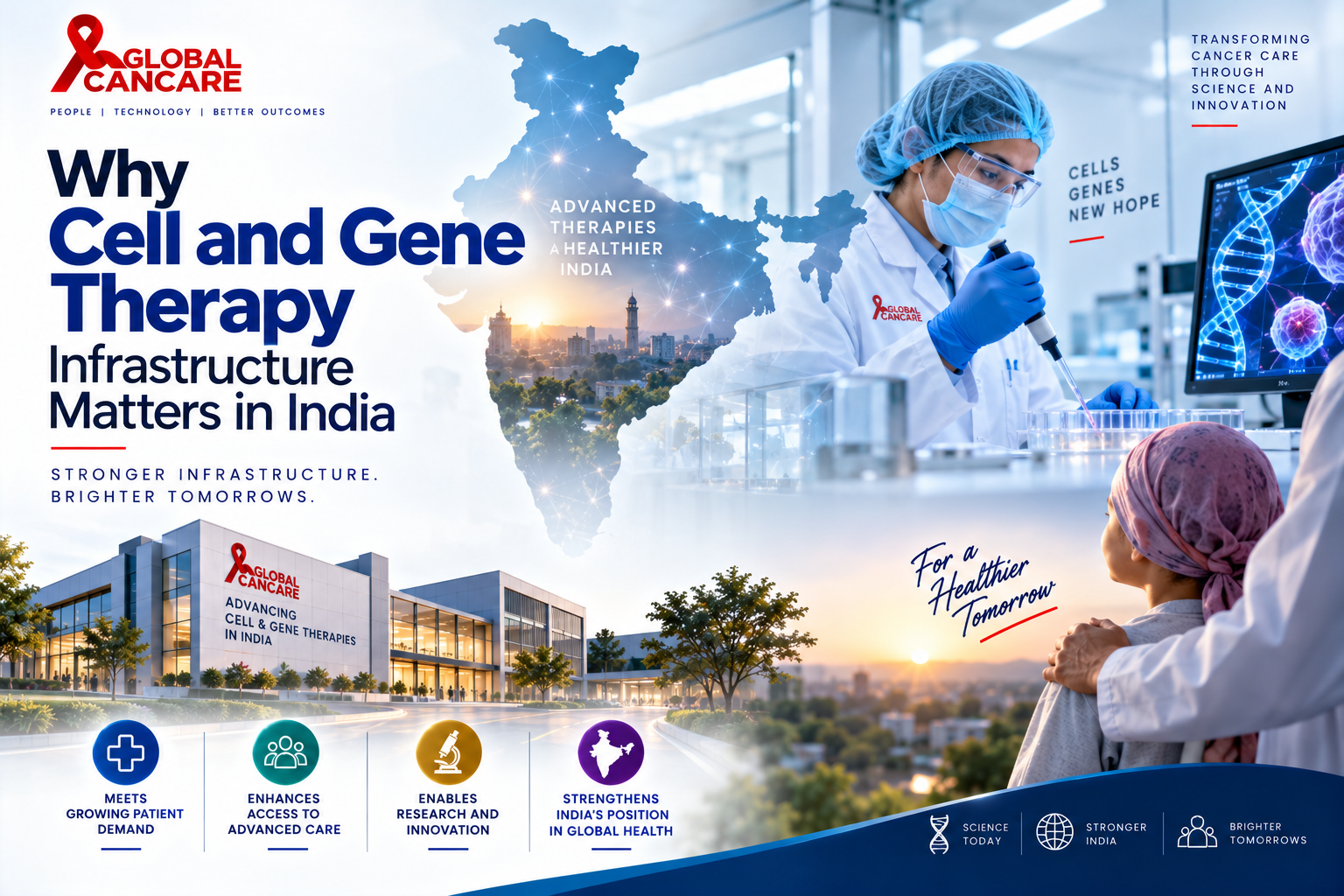
But successful cell and gene therapy infrastructure in India will require more than individual treatment centres. Hospitals need connected systems that can support patient care, specialised processing, quality management, traceability, storage, research, and collaboration.
This is where infrastructure planning becomes a strategic issue. A hospital that plans its CGT facility requirements around the complete therapy pathway can create a stronger foundation for clinical delivery and future expansion.
Global CanCare is positioned within this infrastructure opportunity, bringing together Cell & Gene Therapy planning and healthcare infrastructure capabilities to help institutions develop facilities designed for advanced therapies.
The strategic goal is simple: create infrastructure that can support today's therapies while remaining ready for the next generation of gene and cell therapy.
Conclusion: Cell and Gene Therapy Infrastructure
Launching a cell and gene therapy program is an infrastructure challenge as much as it is a clinical opportunity. Hospitals need to connect treatment areas, processing environments, quality systems, cryogenic storage, traceability, logistics, biosafety, specialist teams, and regulatory planning.
For cell and gene therapy infrastructure India, the strongest approach is to design the complete ecosystem before launching the program.
Global CanCare Pvt. Ltd. brings an integrated infrastructure perspective to Cell & Gene Therapy, helping healthcare organisations plan facilities and systems that are aligned with advanced-therapy requirements and future growth.
The future of gene and cell therapy will depend not only on scientific breakthroughs, but also on whether hospitals have the infrastructure to deliver those breakthroughs safely and effectively.
Frequently Asked Questions
Q1. What is cell and gene therapy infrastructure?
Answer: Cell and gene therapy infrastructure is the combination of clinical facilities, laboratories, controlled environments, storage, equipment, quality systems, logistics, safety measures, and trained teams needed to deliver or process advanced cell and gene therapies.
Q2. What are the main CGT facility requirements?
Answer: The main CGT facility requirements depend on the therapy and operating model but may include clinical treatment areas, controlled processing environments, cryogenic storage, quality systems, traceability, biosafety, specialised equipment, trained staff, and appropriate regulatory processes.
Q3. Does every hospital need to manufacture cell and gene therapies?
Answer: No. Some hospitals may only administer therapies manufactured at an external facility. Others may perform collection, processing, research, or manufacturing activities. Infrastructure should therefore be designed around the hospital's specific CGT model.
Q4. Why is traceability important in cell and gene therapy?
Answer: Traceability helps maintain a clear connection between the patient and their biological material throughout collection, processing, storage, transportation, and treatment. It is particularly important for personalised therapies.
Q5. What should hospitals consider when developing cell and gene therapy infrastructure in India?
Answer: Hospitals should assess the therapy type, clinical workflow, processing requirements, facility design, quality systems, cryogenic storage, logistics, biosafety, staffing, regulatory requirements, and future expansion needs.
Q6. How does Global CanCare support Cell & Gene Therapy infrastructure?
Answer: Global CanCare supports Cell & Gene Therapy infrastructure through an integrated approach covering facility planning, laboratory infrastructure, controlled environments, clinical research requirements, and turnkey healthcare infrastructure.
Authoritative Sources
Planning a Cancer Care project?
Our specialists can scope equipment, shielding, licensing and staffing for your facility.
Talk to our team