
Medical Cyclotron
Medical Cyclotron ROI Explained: Costs, Revenue, Break-Even Analysis & Payback Period
Planning a medical cyclotron? Learn the true investment cost, ROI, revenue streams, break-even period, and the key factors that determine long-term profitability.
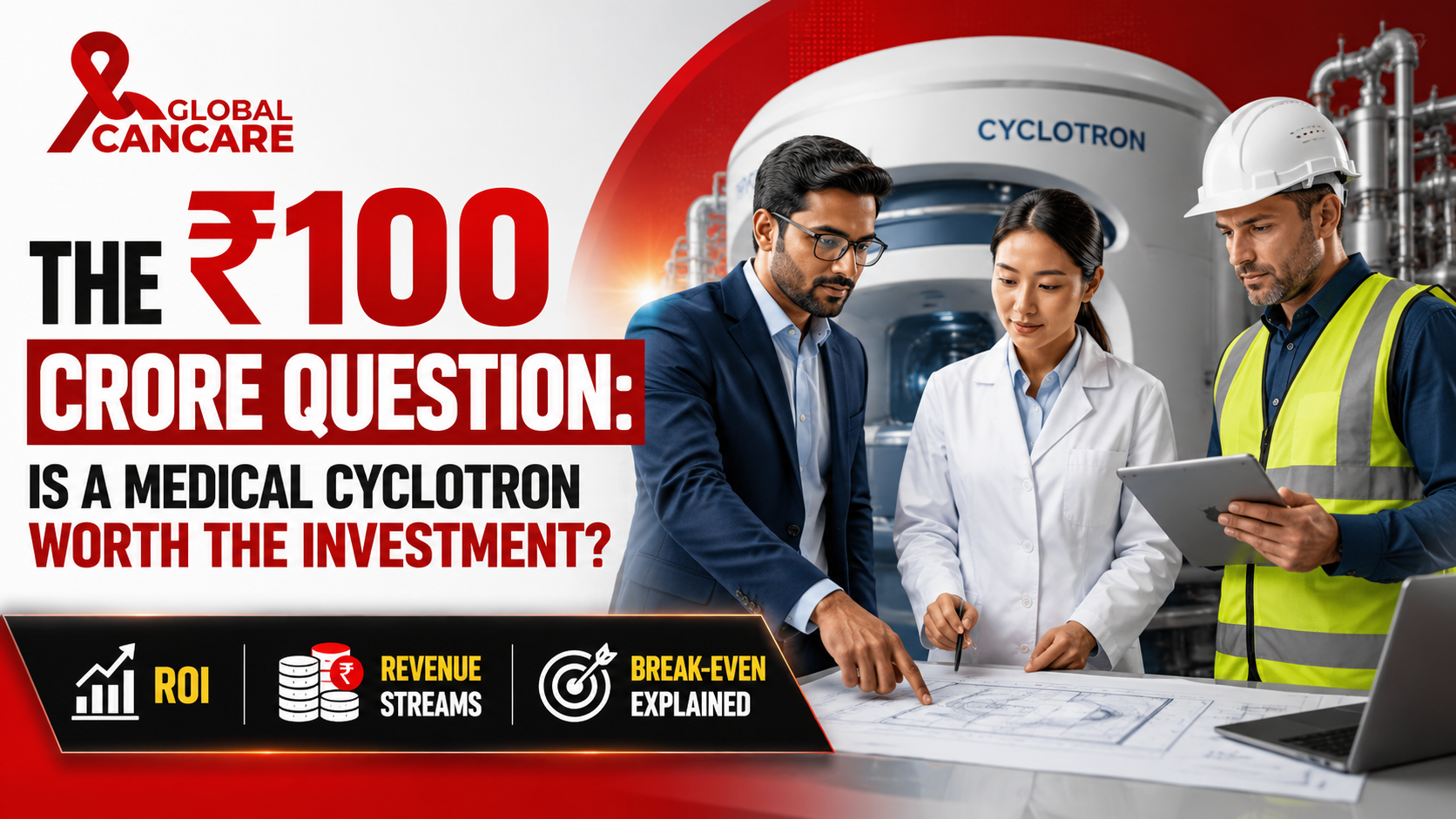
Medical Cyclotron ROI: How Long Does It Really Take to Pay for Itself?
A medical cyclotron is one of the biggest capital investments a hospital or cancer centre can make.
A medical cyclotron typically costs between US$1.5 million and US$5 million (approximately ₹12.5 crore to ₹41 crore) for the equipment alone.
However, purchasing the cyclotron is only the first step.
A fully operational cyclotron facility—including the cyclotron, radiation shielding, concrete bunker, radiopharmacy, hot cells, quality control laboratory, HVAC systems, utilities, installation, commissioning, and regulatory approvals—can require a total investment of US$10 million to US$30 million (approximately ₹80 crore to ₹250 crore).
Naturally, every hospital board asks the same question.
Will this investment pay for itself?
The answer is yes—but only if the project is planned correctly.
Unlike an MRI or CT scanner, a cyclotron doesn't generate revenue from a single service.
Instead, it becomes the foundation of an entire nuclear medicine ecosystem, supporting PET-CT imaging, radiopharmaceutical production, theranostics, cancer research, clinical trials, and regional isotope distribution.
According to the International Atomic Energy Agency (IAEA), successful cyclotron projects should be planned around projected patient demand, isotope distribution logistics, and long-term operational sustainability—not simply equipment selection.
Medical Cyclotron ROI at a Glance
Metric | Typical Range* |
|---|---|
Total Project Investment | ₹80–250+ Crore |
Cyclotron Equipment Cost | ₹12.5–41 Crore |
Equipment Share of Total Investment | 30–40% |
Typical Financial Payback | 3–7 Years* |
Primary Revenue Drivers | PET Imaging, FDG Production, Isotope Supply, Theranostics |
Biggest ROI Driver | Daily PET Scan Volume & Cyclotron Utilisation |
Illustrative industry benchmarks. Actual ROI depends on patient demand, reimbursement, financing, isotope portfolio, operating costs, cyclotron capacity, and project execution.
Key Takeaway: Hospitals don't generate ROI by buying a cyclotron. They generate ROI by building a high-utilisation nuclear medicine programme.
Why Medical Cyclotron ROI Is Becoming More Important Than Ever
Cancer is one of the fastest-growing healthcare challenges worldwide.
As cancer incidence rises, so does the demand for PET-CT imaging, molecular diagnostics, and precision oncology.
India alone reports nearly 1.5 million new cancer cases every year, creating sustained demand for advanced nuclear medicine services.
PET-CT installations have increased rapidly over the last decade.
However, the number of cyclotron facilities has not grown at the same pace.
Many hospitals still rely on externally supplied FDG, making them vulnerable to transport delays, radioactive decay, and limited scheduling flexibility.
Every cancelled or delayed PET scan represents more than an operational problem.
It also means lost revenue and delayed patient care.
Today's cyclotron projects are no longer designed only for diagnostic imaging.
They are increasingly planned to support theranostics, research programmes, isotope manufacturing, and regional radiopharmaceutical distribution.
Market Trend | Why It Matters for ROI |
Rising cancer incidence | Increases PET imaging demand |
Growth in PET-CT installations | Higher isotope consumption |
Expansion of theranostics | Creates new revenue opportunities |
Regional cancer networks | Supports isotope distribution |
Research collaborations | Generates additional funding opportunities |
Key Takeaway: Growing demand creates opportunity, but only well-planned, high-utilisation facilities convert that demand into sustainable financial returns.
What Does a Medical Cyclotron Project Actually Cost?
Many hospital administrators focus only on the purchase price of the cyclotron.
That's one of the most common financial mistakes when buying a cyclotron.
The cyclotron itself generally accounts for only 30–40% of the total project investment.
The remaining budget goes toward the specialised infrastructure required to safely manufacture and handle medical radioisotopes.
This includes radiation shielding, civil construction, radiopharmacy facilities, hot cells, quality control laboratories, HVAC systems, electrical infrastructure, licensing, validation, commissioning, and trained personnel.
Ignoring these costs often leads to unrealistic financial projections.
Project Component | Typical Share of Total Investment |
Medical Cyclotron | 30–40% |
Civil Construction & Vault | 10–20% |
Radiation Shielding | 10–15% |
Radiopharmacy & Hot Cells | 15–20% |
HVAC & Utilities | 5–10% |
Quality Control Laboratory | 3–5% |
Licensing & Validation | 2–5% |
Installation & Commissioning | 2–5% |
Initial Working Capital | 5–10% |
For example, a hospital purchasing a ₹35 crore cyclotron may ultimately invest ₹80 crore or more before the first commercial PET scan is performed.
That's why financial planning should always consider the total project investment, not simply the equipment cost.
Key Takeaway: The cyclotron is only one part of the investment. Infrastructure and project execution ultimately determine long-term ROI.
Where Does the Revenue Come From?
One of the biggest misconceptions about a medical cyclotron is that it exists only to support PET scans.
In reality, a cyclotron creates multiple revenue opportunities from the same infrastructure.
Hospitals that rely on only one source of income often experience longer payback periods.
Those that diversify their services generally achieve stronger financial performance.
A well-planned cyclotron project can generate revenue from diagnostic imaging, isotope manufacturing, regional supply, research, and advanced cancer therapies.
Revenue Stream | Current Revenue Potential | Future Growth Potential |
PET-CT Imaging | High | High |
Internal FDG Production | High | High |
FDG Supply to Other Hospitals | High | Very High |
Other PET Radioisotopes | Medium | High |
Research & Clinical Trials | Medium | Medium |
Theranostics Support | Medium | Very High |
Each additional revenue stream increases cyclotron utilisation.
Higher utilisation spreads fixed operating costs across more procedures, improving overall profitability.
Key Takeaway: A cyclotron is far more than a diagnostic machine. It is a long-term production asset capable of supporting multiple revenue streams.
Revenue Stream #1: PET-CT Imaging
PET-CT imaging remains the largest source of revenue for most medical cyclotron facilities.
Every PET scan requires a radiopharmaceutical that must be produced shortly before patient administration.
Unlike conventional medicines, PET tracers cannot be manufactured weeks in advance and stored on a shelf.
This creates continuous demand for reliable isotope production.
Hospitals performing higher PET scan volumes generally achieve better cyclotron utilisation.
Higher utilisation reduces the production cost per dose and improves financial returns.
However, there is no fixed number of scans that guarantees profitability.
The break-even point depends on reimbursement rates, isotope demand, operating costs, referral networks, and distribution strategy.
Daily PET Scan Volume | Typical Business Impact |
|---|---|
Below 10 Scans | Often dependent on external isotope suppliers |
10–20 Scans | Business case depends on local demand and pricing |
20–40 Scans | Strong utilisation with improving ROI |
Above 40 Scans | Excellent utilisation and expansion potential |
Hospitals with multiple PET-CT scanners generally make better use of cyclotron capacity than facilities operating a single scanner.
As patient volumes grow, the fixed operating costs are distributed across more scans, improving overall profitability.
Key Takeaway: Patient volume is one of the most important drivers of medical cyclotron ROI, but it should always be evaluated alongside distribution opportunities and long-term demand.
Revenue Stream #2: FDG Production and Regional Distribution
Many hospitals evaluate a cyclotron only for their own PET imaging requirements.
That approach often leaves significant revenue untapped.
A cyclotron can also manufacture Fluorine-18 Fluorodeoxyglucose (¹⁸F-FDG) for nearby hospitals, diagnostic centres, and cancer institutes.
Instead of serving one hospital, the facility becomes a regional isotope production hub.
This business model increases cyclotron utilisation without proportionally increasing capital investment.
According to the IAEA, centralized cyclotron facilities supplying multiple PET centres can improve efficiency by spreading production costs across a larger customer base.
Distribution Model | Expected Impact on ROI |
|---|---|
Internal Hospital Use Only | Moderate |
Supply 2–3 Nearby Hospitals | High |
Regional FDG Distribution Network | Very High |
Multi-City Radiopharmaceutical Hub | Maximum Long-Term Potential |
Every additional customer increases production efficiency.
The cyclotron continues operating, but each production batch serves more patients and generates additional revenue.
Key Takeaway: For many hospitals, regional FDG distribution generates higher long-term returns than internal PET imaging alone.
Why Radioactive Decay Directly Affects Cyclotron ROI
Medical cyclotrons produce isotopes with extremely short half-lives.
Unlike conventional pharmaceuticals, these products begin losing value immediately after production.
The most widely used PET isotope, Fluorine-18, has a physical half-life of approximately 110 minutes.
That means every delay reduces the usable activity available for patient imaging.
Time After Production | Approximate Remaining F-18 Activity |
|---|---|
Immediately After Production | 100% |
After 110 Minutes | 50% |
After 220 Minutes | 25% |
After 330 Minutes | 12.5% |
Poor scheduling, delayed transportation, or inefficient workflows don't just affect patient appointments.
They also reduce the number of usable doses that can be delivered.
This directly impacts revenue.
That's why successful cyclotron facilities invest as much in logistics, production planning, and quality control as they do in equipment.
Key Takeaway: Every minute matters. Efficient production, scheduling, and delivery protect isotope value and maximise financial returns.
Beyond FDG: New Revenue Opportunities in Theranostics
The business case for medical cyclotrons is expanding.
While ¹⁸F-FDG remains the most widely used PET radiopharmaceutical, hospitals are increasingly investing in other PET tracers and theranostic programmes.
These services support more personalised cancer diagnosis and treatment while creating additional revenue streams.
As precision oncology continues to grow, demand for advanced radiopharmaceuticals is expected to increase.
Hospitals that plan for future isotope production today will be better positioned for tomorrow's clinical needs.
Emerging Opportunity | Business Benefit |
|---|---|
Additional PET Tracers | Better cyclotron utilisation |
Theranostics | Higher-value oncology services |
Clinical Research | New funding opportunities |
Academic Collaborations | Expanded research programmes |
Future Isotope Portfolio | Long-term revenue diversification |
A cyclotron designed only for today's demand may limit future growth.
Facilities designed with expansion in mind can adapt more easily as new clinical applications emerge.
Key Takeaway: The strongest cyclotron projects are built for the next decade—not just the next few years.
How Do Hospitals Calculate Medical Cyclotron ROI?
Purchasing a cyclotron is a strategic investment, not just a capital expense.
Before approving a project, hospital boards and investors typically ask one question.
How quickly will the investment generate positive returns?
Answering that requires much more than comparing equipment prices.
A comprehensive cyclotron feasibility study evaluates projected revenue, operating costs, patient demand, financing, depreciation, and future expansion opportunities.
Rather than relying on a single metric, most hospitals assess several financial indicators together.
Financial Metric | What It Measures | Why It Matters |
|---|---|---|
Return on Investment (ROI) | Overall profitability | Shows whether the investment creates value |
Payback Period | Time to recover the investment | Helps assess financial risk |
Net Present Value (NPV) | Lifetime project value | Accounts for future cash flows |
Internal Rate of Return (IRR) | Expected annual return | Compares investment opportunities |
EBITDA | Operating profitability | Measures day-to-day financial performance |
No single number tells the complete story.
For example, two hospitals may purchase the same cyclotron at the same price but achieve completely different financial outcomes because of patient volume, referral networks, or isotope distribution.
That's why financial modelling should begin before equipment selection.
Key Takeaway: Successful cyclotron projects are built on detailed financial modelling, not equipment quotations.
Medical Cyclotron Break-Even Analysis: A Practical Example
Let's compare two hospitals investing in similar cyclotron facilities.
Both spend approximately ₹80 crore on their projects.
However, their operating models are very different.
Example 1: Hospital-Based PET Centre
Financial Parameter | Value |
|---|---|
Total Project Investment | ₹80 Crore |
Annual Operating Cost | ₹14 Crore |
Annual Revenue | ₹22 Crore |
Annual Operating Surplus | ₹8 Crore |
Estimated Payback Period* | ~8–10 Years |
This hospital operates mainly for its own PET-CT department.
It has limited external isotope sales.
Although clinically successful, the financial recovery is relatively slow.
Example 2: Regional Cyclotron Hub
Financial Parameter | Value |
|---|---|
Total Project Investment | ₹80 Crore |
Annual Operating Cost | ₹16 Crore |
Annual Revenue | ₹40 Crore |
Annual Operating Surplus | ₹24 Crore |
Estimated Payback Period* | ~3–5 Years |
This facility supplies FDG to multiple hospitals while also supporting its own PET-CT services.
The higher utilisation significantly improves financial performance.
The capital investment is almost identical.
The business model is completely different.
Illustrative examples only. Actual financial performance varies by reimbursement, financing, utilisation, isotope portfolio, and operating efficiency.
Key Takeaway: Higher utilisation and diversified revenue streams usually shorten the payback period far more than reducing equipment costs.
Standalone PET Centre vs Regional Cyclotron Hub
Not every cyclotron operates the same way.
Some hospitals install a cyclotron only to support their own imaging department.
Others build regional production centres supplying multiple healthcare providers.
The difference has a major impact on ROI.
Parameter | Standalone PET Centre | Regional Cyclotron Hub |
|---|---|---|
PET-CT Scanners | 1 | 2–5 |
Daily PET Patients | 15–25 | 50–100+ |
External Hospitals Served | None | Multiple |
FDG Distribution | Limited | Extensive |
Cyclotron Utilisation | Moderate | High |
Future Expansion | Limited | Strong |
Long-Term ROI Potential | Moderate | High |
A regional hub distributes fixed operating costs across many more doses.
That lowers the production cost per dose while increasing revenue.
It also creates stronger relationships with surrounding hospitals and diagnostic centres.
Key Takeaway: A cyclotron becomes significantly more valuable when it supports an entire regional healthcare network rather than a single hospital.
The Hidden Costs That Can Reduce Cyclotron ROI
Capital expenditure receives the most attention.
Operating expenses often determine whether the project succeeds financially.
Many first-time buyers underestimate these recurring costs.
Operating Expense | Typical Impact |
|---|---|
Electricity Consumption | High |
Helium & Technical Gases | Medium |
Target Foils | Medium |
Radiochemistry Consumables | High |
Quality Control Reagents | Medium |
Annual Maintenance Contract | High |
Qualified Technical Staff | High |
Regulatory Compliance | Medium |
Radioactive Waste Management | Medium |
Equipment Downtime | Very High |
These costs continue whether the cyclotron produces ten doses or one hundred doses.
Low utilisation therefore increases the production cost of every radiopharmaceutical.
Efficient scheduling and consistent production are essential for maintaining profitability.
Key Takeaway: The cost of operating an underutilised cyclotron is often much higher than hospitals expect.
Five Factors That Influence Cyclotron ROI the Most
Not every operational factor affects profitability equally.
Some decisions have a much greater impact on financial performance than others.
Factor | Impact on ROI |
|---|---|
Daily PET Scan Volume | Very High |
FDG Distribution Network | Very High |
Cyclotron Utilisation | Very High |
Referral Network Strength | High |
Equipment Uptime | High |
Radiopharmacy Efficiency | High |
Future Theranostics Capability | Medium–High |
Research Partnerships | Medium |
Many hospitals focus heavily on negotiating equipment prices.
In reality, improving utilisation by just a small margin often creates greater financial value than reducing the initial purchase price.
A cyclotron that operates close to capacity usually delivers substantially stronger long-term returns than one that remains underutilised.
Key Takeaway: Long-term ROI depends far more on utilisation than on the initial equipment cost.
Common Mistakes That Delay Cyclotron Payback
Most cyclotron projects don't underperform because of the technology.
They underperform because of planning mistakes made long before the first isotope is produced.
A cyclotron is a long-term healthcare infrastructure project.
Treating it like a standalone equipment purchase often leads to lower utilisation, higher operating costs, and slower financial returns.
Common Mistake | Impact on ROI |
|---|---|
Buying the wrong cyclotron capacity | Lower utilisation and unnecessary capital costs |
Overestimating PET demand | Longer payback period |
No regional distribution strategy | Missed isotope revenue |
Weak referral network | Low patient volumes |
Poor radiopharmacy design | Lower production efficiency |
Delayed regulatory approvals | Delayed commercial operations |
Inadequate workforce planning | Higher operating risk |
No future expansion plan | Limited long-term growth |
Many of these issues are avoidable.
They can be identified during the feasibility and planning stage, before construction even begins.
Key Takeaway: Most ROI challenges are caused by planning decisions—not by the cyclotron itself.
How Hospitals Can Maximise Medical Cyclotron ROI
A successful cyclotron programme isn't built by reducing costs alone.
It's built by increasing utilisation, expanding services, and improving operational efficiency.
Hospitals that continuously optimise their business model generally achieve faster payback and stronger long-term returns.
Strategy | Business Benefit |
|---|---|
Increase daily PET scan volumes | Higher imaging revenue |
Supply FDG to nearby hospitals | Additional recurring income |
Produce multiple PET tracers | Better cyclotron utilisation |
Expand into theranostics | Higher-value oncology services |
Build a stronger referral network | More consistent patient flow |
Minimise equipment downtime | Higher productivity |
Optimise production scheduling | Lower isotope wastage |
Collaborate with research institutions | Additional grants and clinical projects |
No single strategy transforms ROI overnight.
However, combining multiple initiatives can significantly improve the financial performance of the facility over its lifetime.
Key Takeaway: The highest-performing cyclotron facilities continuously improve utilisation rather than simply controlling costs.
Should Your Hospital Invest in a Medical Cyclotron?
A medical cyclotron is not the right solution for every hospital.
For smaller imaging centres located near reliable isotope suppliers, purchasing FDG may remain the most economical option.
However, hospitals with growing PET-CT demand, expanding oncology services, or regional referral networks often benefit from producing radioisotopes in-house.
The decision should never be based on equipment price alone.
It should be based on patient demand, geography, logistics, reimbursement, and long-term clinical strategy.
Consideration | Purchase FDG | Invest in a Cyclotron |
|---|---|---|
Initial Capital Investment | Low | High |
Control Over Isotope Supply | Limited | Complete |
Long-Term Operating Flexibility | Moderate | High |
Regional Distribution Capability | No | Yes |
Research & Academic Opportunities | Limited | Extensive |
Future Theranostics Readiness | Limited | Strong |
Scalability | Limited | Excellent |
Every project is different.
A detailed feasibility study provides the financial and operational evidence needed to make the right investment decision.
Key Takeaway: The right decision isn't whether to buy a cyclotron—it's whether your hospital can fully utilise one.
Frequently Asked Questions (FAQs)
1. How much does a medical cyclotron cost?
A medical cyclotron typically costs US$1.5 million to US$5 million (approximately ₹12.5 crore to ₹41 crore) for the equipment alone. A complete cyclotron facility, including infrastructure and radiopharmacy, can require a total investment of US$10 million to US$30 million (approximately ₹80 crore to ₹250 crore).
2. What is the typical payback period for a medical cyclotron?
Well-planned, high-utilisation facilities often achieve a payback period of 3–7 years, although the actual timeline depends on patient volume, reimbursement, operating costs, financing, and isotope distribution.
3. What is the biggest factor affecting cyclotron ROI?
The biggest driver is cyclotron utilisation. Higher PET scan volumes, regional FDG supply, and multiple revenue streams generally improve financial performance.
4. Can a cyclotron generate revenue beyond PET imaging?
Yes. Modern cyclotron facilities can generate revenue through FDG production, regional isotope distribution, research collaborations, clinical trials, additional PET tracers, and theranostics programmes.
5. Does every hospital need a cyclotron?
No. Hospitals should evaluate patient demand, referral patterns, logistics, and financial feasibility before investing in a cyclotron.
Final Thoughts
A medical cyclotron is much more than a sophisticated piece of equipment.
It is the foundation of a comprehensive nuclear medicine programme.
When supported by the right infrastructure, referral network, radiopharmacy, and distribution strategy, it can improve patient access while creating sustainable long-term financial returns.
The most successful projects don't begin with equipment selection.
They begin with a detailed feasibility study, accurate demand forecasting, and a clear business model.
That's what ultimately determines whether a cyclotron becomes a cost—or a long-term strategic asset.
Key Takeaway: The strongest cyclotron projects are built around demand, utilisation, and long-term growth—not simply around technology.
Why Choose Global CanCare for Your Cyclotron Needs
Building a successful cyclotron facility requires much more than purchasing equipment.
It requires expertise in healthcare planning, infrastructure development, regulatory compliance, radiopharmacy, radiation shielding, workflow design, commissioning, and long-term operational planning.
Global CanCare partners with hospitals, cancer centres, research institutions, and investors to deliver complete end-to-end cyclotron projects.
From feasibility studies and financial modelling to technology selection, infrastructure planning, installation, commissioning, and operational readiness, our multidisciplinary team supports every stage of the project lifecycle.
Whether you're planning your first hospital-based PET-CT centre, expanding into regional FDG production, or developing a comprehensive nuclear medicine network, we help you build a facility designed for clinical excellence and long-term financial sustainability.
Planning a medical cyclotron project? Connect with Global CanCare to evaluate your project before you invest—and build a facility that's designed for both better patient care and stronger long-term ROI.
Ready to Evaluate Your Cyclotron Project?
Talk to our experts for a confidential consultation on project feasibility, financial modelling, infrastructure planning, technology selection, and implementation.
Head Office (Delhi, India)
📧 info@globalcancare.com
📞 +91 81201 15666
Regional Offices
Mumbai: +91 90987 93898
Bangalore / Kolkata: +91 79746 67979
United Kingdom: uk@globalcancare.com
United States: usa@globalcancare.com
Australia: australia@globalcancare.com
United Arab Emirates: uae@globalcancare.com
General Enquiries
📧 info@globalcancare.com
Global CanCare
Building Complete Cancer Care Ecosystems
*Start your cyclotron project with confidence. Contact Global CanCare today to discuss your requirements and discover how we can help you build a financially sustainable, future-ready nuclear medicine facility.
Planning a Cancer Care project?
Our specialists can scope equipment, shielding, licensing and staffing for your facility.
Talk to our team